



The short answer: Both Influx and SupportNinja are credible CX outsourcing providers, but they serve meaningfully different buyer profiles. Influx is purpose-built for brands that need to launch fast, scale up or down month-to-month, and get fully managed support and AI management, without long procurement cycles. SupportNinja positions itself as a strategic outsourcing partner for SaaS and tech companies that want AI integration and full-lifecycle CX management. The better choice depends on where you are in your growth curve, how much operational control you want to hand off, and how urgently you need coverage.
How we evaluated these providers
This comparison assessed Influx and SupportNinja across six dimensions: onboarding speed, pricing model transparency, service model flexibility, AI and technology integration, industry breadth, and management depth. Data was drawn from each company's published documentation, third-party review aggregators, and publicly available case studies. Where direct comparisons were not available, both companies were evaluated using the same criteria applied consistently.
The outsourcing maturity spectrum framework
Before diving into the comparison, it helps to place both providers on what we call the Outsourcing Maturity Spectrum, a three-stage model describing how companies evolve in their use of external CX partners:
Stage 1: Operational relief. You need coverage now. You're drowning in tickets, have seasonal spikes, or can't yet justify a full in-house team. Speed and flexibility matter more than strategic depth.
Stage 2: Brand extension. Your support team needs to feel indistinguishable from your internal team. Quality, brand voice consistency, and QA oversight become the primary concerns.
Stage 3: Strategic CX partnership. You want your outsourcing vendor co-designing your CX strategy, integrating AI into your workflow, managing renewals, and contributing to revenue metrics like ARR per FTE and retention rates.
Influx competes strongly across the 3 stages while SupportNinja is strong at Stages 2 and 3. Understanding which stage your business is at will do more to clarify this decision than any feature checklist.
This distinction matters because while cost savings remain the top concern in outsourcing decisions, quality service has emerged as the more critical factor. The buyer market has matured, and so have the requirements for the vendors serving it.
Provider overview
Influx
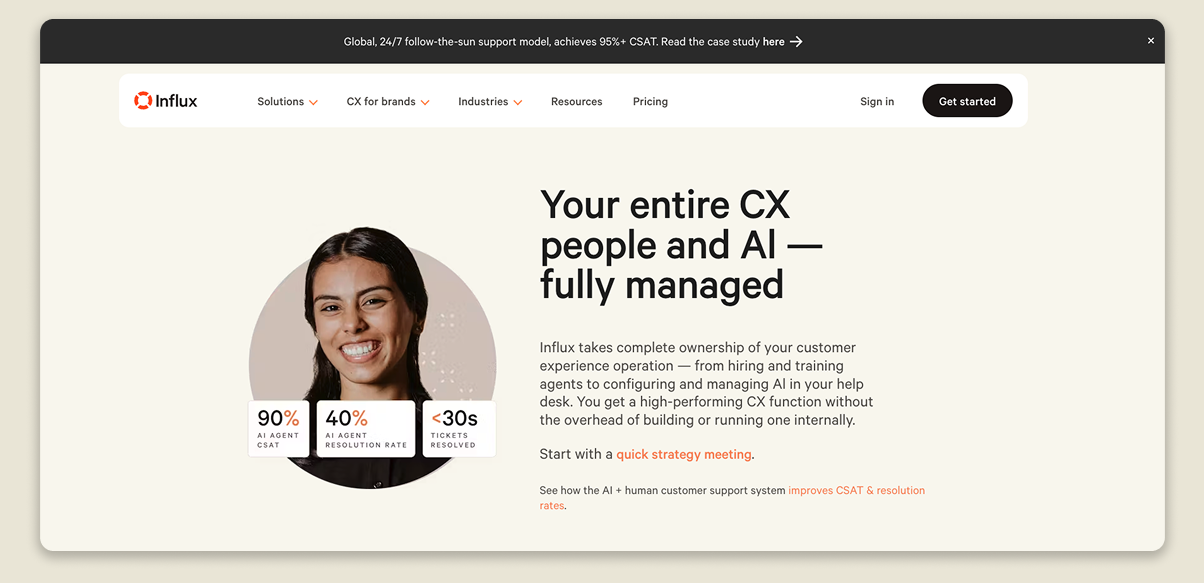
Founded in 2013, Influx describes its model as “support ops on demand,” a fully managed, month-to-month CX operation built around a follow-the-sun coverage model. Influx uses a follow-the-sun model based on regular business hours and no graveyard shifts, allowing clients to fill internal coverage gaps or extend their team to get quality support at all hours, backed by a 100% remote and global workforce.
The company is trusted by 750+ partners across eCommerce, health/wellness, tech, and travel, and operates a global network spanning over 123 cities worldwide. Its pricing is published and tiered: you can get a pre-selected agent that you can manage for $1,000/month (part-time) or $1,400/month (full-time). For clients that want a fully managed operation, pricing starts at just $2,000/agent/month.
Influx's defining differentiator is speed of deployment. Agents can be live and handling tickets within five business days of contract signing, enabled by a proactive recruitment approach that maintains a pre-vetted talent pipeline rather than beginning the search after a contract is signed.
Best for: eCommerce and D2C brands, startups scaling quickly, businesses with seasonal volume swings, and companies that want management included without hiring a CX ops leader internally.
SupportNinja
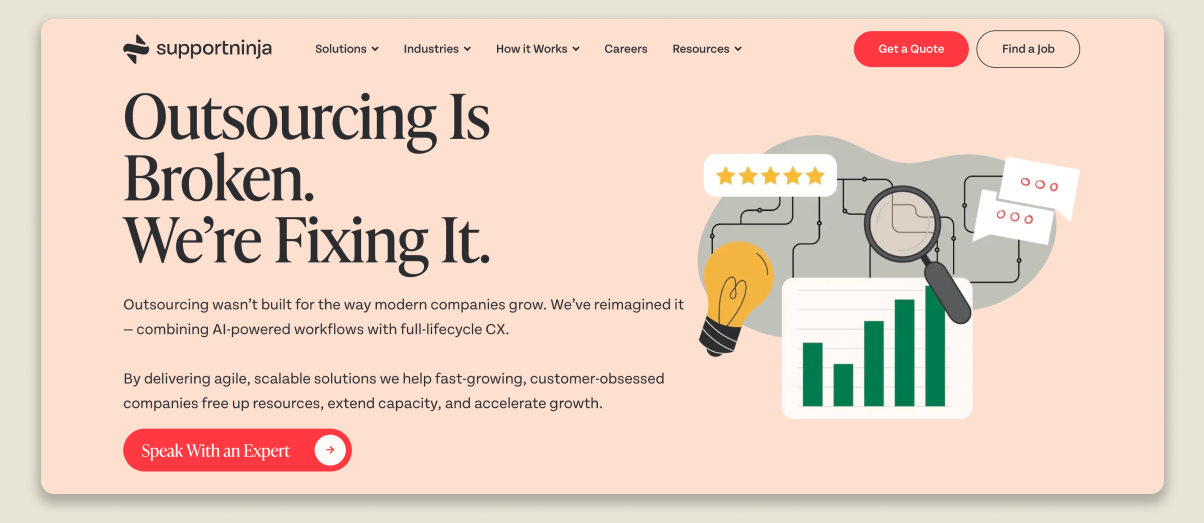
Founded in 2015 and headquartered in Austin, Texas, SupportNinja has grown consistently, appearing on the Inc. 5000 list for four consecutive years and now positions itself as a full-lifecycle CX outsourcing partner under what it calls the "Outsourcing 2.0" model. SupportNinja combines AI-powered workflows with full-lifecycle CX, helping fast-growing, customer-obsessed companies free up resources, extend capacity, and accelerate growth.
Their onboarding timeline is more extended than Influx's: recruitment can take two to four weeks to source a team, followed by an additional two to four weeks of training, meaning agents typically live six to eight weeks from project kickoff.
SupportNinja does not publish pricing publicly; you'll need to go through a sales process to get a quote, which some teams find a friction point when they want to compare costs quickly.
Best for: SaaS companies managing complex customer lifecycles, businesses that want to embed AI into their support stack from day one, and organizations seeking a vendor capable of contributing to retention and expansion revenue.
Influx vs SupportNinja: Head-to-head comparison
| Attribute | Influx | SupportNinja |
|---|---|---|
| Founded | 2013 | 2015 |
| Pricing model | Published, per-agent or per-response | Custom quote, fixed per-agent |
| Minimum engagement | From $1000/month | Not published |
| Onboarding timeline | As fast as 5 business days | Typically 4-8 weeks |
| Contract commitment | Month-to-month, no lock-in | Not published (varies by model) |
| Management included | Yes, fully managed | Yes (managed model) or optional (hands-on model) |
| AI integration | Human + AI teams as well as AI management | AI-enabled workflows (NinjaAI) |
| Service models | Shared agents, dedicated agents, enterprise | Dedicated managed, dedicated hands-on |
| Primary verticals | eCommerce, tech, health, travel, SaaS | SaaS, eCommerce, fintech, healthcare, logistics |
| Follow-the-sun coverage | Yes, core to the model | Yes |
| Pricing transparency | High: tiers published | Low: requires sales contact |
| Notable CSAT results | 94-95% (based on public case studies) | Client-reported improvements cited but not benchmarked publicly |
| Languages supported | 10+ | 10+ |
| Channels supported | Email, chat, voice, social, back office | Email, chat, voice, social, back office |
Where Influx has a clear edge
1. Speed to value
For businesses that need coverage immediately, Influx has a structural advantage. The five-business-day go-live timeline is enabled by maintaining a standing talent pool of pre-vetted agents, which means client-specific training begins almost immediately after contract signing.
SupportNinja's four-to-eight-week timeline is due to their agent-matching process, but for brands managing a ticket backlog or launching a new channel, the gap is meaningful.
In one documented case, Influx cleared a 15,600+ ticket backlog with ten Zendesk agents while simultaneously establishing 24/7 coverage. That kind of deployment speed is rare in traditional outsourcing arrangements.
2. Pricing transparency
SupportNinja doesn't publish pricing, so you'll need to go through a sales process just to get a quote, a hurdle for teams that want to compare costs quickly. Influx publishes entry-level pricing across all three of its service tiers.
For a CFO evaluating options or a startup founder working with a limited budget, being able to model costs before entering a sales conversation removes real friction. Neither provider charges setup fees, but Influx's published rate structure gives it a transparency advantage at the evaluation stage.
3. Operational flexibility for scaling brands
Influx's month-to-month, no-lock-in model is particularly suited to businesses in growth phases or with unpredictable volume patterns. Influx's flexible service is designed for seasonal coverage, backlog help, and unexpected volume surges, covering recruitment, training, and management so customers never have to wait.
Blenders Eyewear used Influx to handle a 20,000-ticket seasonal burst while maintaining a 94% CSAT. Sendle maintained one-hour response times during a 3x volume peak. These outcomes point to an operational model designed specifically around elasticity.
4. Follow-the-sun coverage without quality compromise
Influx's entire staffing philosophy is built around this model. Its follow-the-sun approach uses agents working during their local daytime hours across multiple time zones, with teams in Indonesia, Kenya, and Jamaica, providing natural 24/7 coverage without anyone working overnight shifts.
Influx cites research showing that overnight shifts produce 11 to 33% slower response times and 15 to 25% higher error rates, along with meaningfully higher rates of sleep disorders among night shift workers. By avoiding graveyard shifts entirely, Influx argues its quality baseline is higher than providers who rely on overnight staffing.
5. Published CSAT benchmarks from real clients
Influx publishes specific performance metrics from named clients: Meshki achieved 95% CSAT while supporting 589% business growth, Blenders achieved 94% CSAT during a high-volume seasonal burst, and ClassPass resolved over 250,000 tickets in a single month using a 76-agent Influx team.
These are concrete, verifiable data points against which buyers can calibrate expectations. SupportNinja's case studies reference performance improvements: one case study documents a 68.6% decrease in first response time and a 50% decrease in resolution time. But its aggregate CSAT benchmarks are not prominently published for direct comparison.
Where SupportNinja has a clear edge
1. Full-lifecycle CX scope
SupportNinja covers full-lifecycle CX, adding value at every stage including onboarding, retention, customer support, and freemium-to-premium conversion. Businesses that want their outsourcing partner to actively contribute to churn reduction and revenue expansion will find SupportNinja's scope more aligned.
2. Dedicated talent matching
SupportNinja's FAQ is explicit: they do not believe in a one-size-fits-all approach, recruiting specifically for each client rather than placing agents from a shared pool. This custom talent-matching approach takes longer but can produce agents with more precisely calibrated skill sets for specialized support needs, particularly relevant for technical SaaS products or regulated industries where agent quality is non-negotiable.
3. Hands-on management option
SupportNinja offers a "hands-on" model in which clients handle interviewing, candidate selection, training, and management themselves, with SupportNinja providing a pre-vetted list of talent to choose from. Influx, by comparison, has a Talent as a Service solution, that is comparable in scope in that Influx handles the people operations of onboarding, roster management, check-ins while giving you the flexibility to direct agents according to your brand needs.
How to choose: decision criteria by buyer type
Choose Influx if:
- You need a live support team within one to two weeks
- Your volume fluctuates seasonally or is growing rapidly
- You want AI embedded into your support workflow from day one
- You want a fully managed operation with no internal CX management overhead
Choose SupportNinja if:
- You're a SaaS or tech company managing multi-stage customer lifecycles
- You need a vendor that can contribute to retention, renewal, and expansion metrics
- You have six to eight weeks to onboard properly before going live
Frequently Asked Questions
How long does it take to go live with Influx?
Influx can have trained agents handling customer tickets within five business days of contract signing. This is enabled by a pre-vetted talent pool and a structured onboarding process that begins client-specific training immediately after kickoff.
How long does onboarding take with SupportNinja?
SupportNinja's typical onboarding timeline is four to eight weeks. This includes two to four weeks for talent sourcing and recruitment, followed by two to four weeks of client-specific training before agents go live.
Does Influx require a long-term contract?
No. Influx operates on a month-to-month basis with no lock-in contracts and no upfront setup fees. Clients can scale team size up or down as needed.
How much does SupportNinja cost?
SupportNinja does not publish pricing. The rate depends on agent location, experience level, technical skills, and whether you choose the managed or hands-on service model. You'll need to contact their sales team for a quote.
Can both providers support omnichannel operations?
Yes. Both Influx and SupportNinja support email, live chat, voice, and social media channels, with integrations available for major help desk platforms including Zendesk. Both also offer back-office support capabilities.
Which provider is better for eCommerce brands?
Influx has a stronger track record in eCommerce, with published CSAT benchmarks from clients like Blenders Eyewear and Meshki. Its follow-the-sun model and flexible scaling are particularly well suited to the seasonal volume patterns common in retail and D2C.
Which provider is better for SaaS companies?
SupportNinja's full-lifecycle model and AI integration depth make it a stronger fit for SaaS companies that need support spanning onboarding, technical troubleshooting, and renewal management. Influx also serves SaaS clients effectively, particularly those prioritizing fast deployment over strategic CX buildout.
What's the ROI timeline for outsourcing customer support?
ROI timelines vary, but research indicates that companies that outsource customer support report improved CSAT scores in roughly 62% of cases. Operational cost savings typically materialize within the first quarter, while quality improvements in first-contact resolution rates compound over three to six months as agents become more familiar with a client's product and brand.
 6 Circle - small.png)