





















Blog > Cx excellence
What’s the difference between customer support, customer success, and customer experience?
If you've sat in a business meeting where "customer support," "customer success" and "customer experience" were used interchangeably, you're not alone. On the surface, all three concepts orbit the same idea: keeping customers happy.
But beneath that surface lies a meaningful (and often costly) distinction. Blurring these three functions doesn't just create org-chart confusion; it creates gaps in the customer journey and missed growth opportunities, the kind that quietly erode retention and revenue over time.
In 2026, as AI reshapes how every one of these functions operates, understanding their differences has become more critical, not less. Let's break down what each one actually means, how they complement each other, and how to think about them in a business landscape where the rules are being rewritten in real time.
What are the pillars of customer support, customer success, and customer experience?
What is customer support and how does it function as the “first responder” for customers?
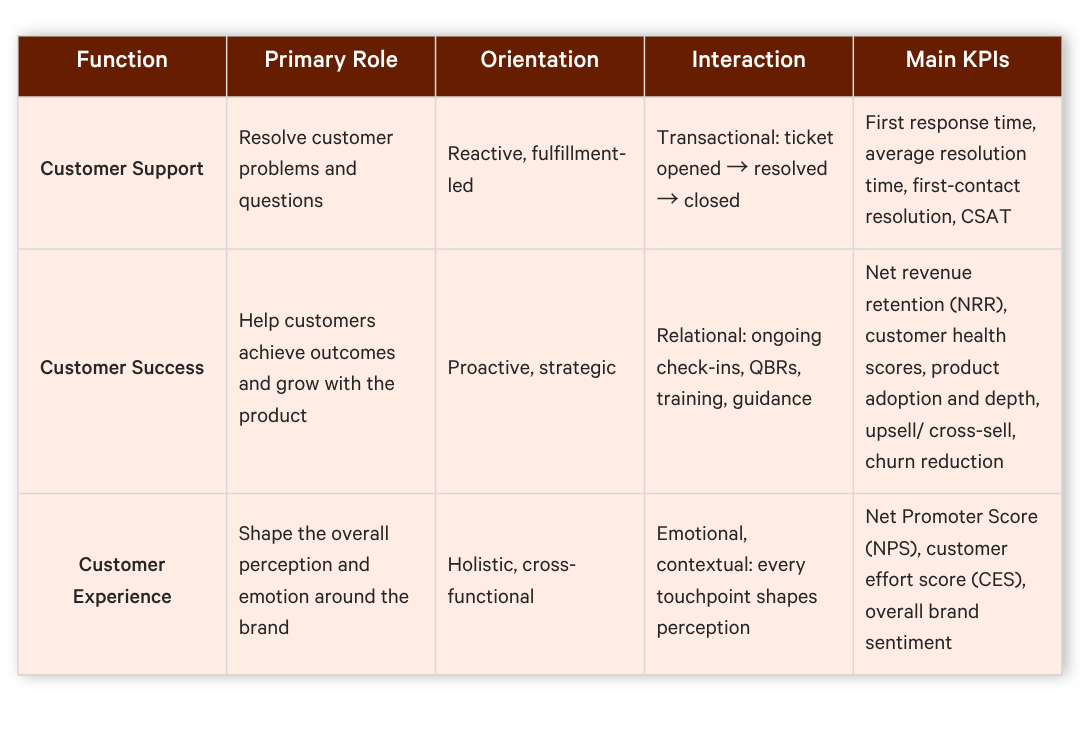
Customer support is reactive by nature. It's the team customers reach out to when something breaks or when they need clarification: a product bug after an update, a billing question, an integration that won't cooperate.
Its goal is fulfillment: when a user encounters a problem they can't solve alone, support steps in to resolve it as quickly as possible.
Support interactions are fundamentally transactional. They have a clear beginning and a clear end: a customer opens a ticket, the issue gets resolved, the ticket is closed. The success of a support team is measured accordingly through metrics like first response time, average resolution time, first-call resolution rates, and customer satisfaction (CSAT) scores.
That said, "reactive" doesn't mean "unimportant." Research consistently shows that support interactions carry enormous weight. 84% of consumers say a positive customer support experience greatly impacts their overall perception of a company.
A support team that performs well isn't just solving problems; it's building trust, one ticket at a time.
What is customer success and how does it act as a strategic partner for customers?
Customer success (CS) operates on an entirely different timeline. It's proactive, goal-oriented, and focused on helping customers achieve meaningful outcomes with your product.
Rather than waiting for problems to arise, CS teams anticipate them. They track product adoption, monitor account health, and step in before frustration becomes churn.
Where support resolves issues, customer success drives progress. A customer success manager (CSM) might conduct a quarterly business review with a key client, flag that they're underutilizing a key feature, roll out training before a major product update, or identify an upsell opportunity that genuinely aligns with the customer's goals.
The relationship is ongoing and evolving, and it continues as long as the customer keeps using the company's products or services.
CS teams are also deeply cross-functional. They collaborate across the business, from sales for handoffs and renewals, to product for roadmap feedback, to marketing for advocacy, to support for consistent delivery.
Their KPIs reflect this long-term orientation: net revenue retention (NRR), customer health scores, product adoption rates, upsell and cross-sell conversion, and churn reduction.
Customer success is particularly central to SaaS and subscription businesses. Higher retention means customers keep paying, increasing lifetime value; and people who find value in your product are more likely to recommend it, which is ultimately how sustainable growth compounds.
What is customer experience and how does it tie together every customer touchpoint?
Customer experience (CX) is the broadest of the three. It's how a customer feels about your brand based on every interaction they have with you: from the moment they first discover your product, through the sales process, onboarding, daily usage, renewal, and beyond.
CX isn't just about the product itself; it includes how easy your website is to navigate, how quickly your support team responds, how personalized your communications feel, and how seamlessly you handle a return or an escalation.
Think of it this way: customer success ensures customers achieve outcomes; customer experience ensures they feel good while doing so. CX is the emotional and holistic layer that sits above both support and success.
It is shaped by all functions across the company (e.g. product, marketing, sales, support, and success) and measured through indicators like Net Promoter Score (NPS), customer effort score (CES), and overall brand sentiment.
The scope of CX is what makes it both powerful and hard to "own." It demands cross-departmental alignment and a shared commitment to the customer journey in its entirety.
Why does it matter to distinguish the three?
If all three functions ultimately want happy customers, why does it matter how you label them?
The answer comes down to focus, accountability, and measurement. Treating these roles as interchangeable leads to gaps in the customer experience and missed growth opportunities.
A support team laser-focused on ticket resolution times may excel at speed but overlook broader patterns signaling that a segment of customers is at risk of churning. A customer success team focused on upsells might miss urgent support pain points if they're not looped into the ticketing system. And a CX strategy that ignores the day-to-day texture of support interactions is building on sand.
The most effective companies understand that these three functions are not competing; they're complementary. As one expert framing puts it:
Support and success are like two eyes: you need both to see the full picture.
When one team misses a signal, the other can catch it. When both are aligned, customers experience one seamless, consistent journey, even when they're technically touching different teams.
How do customer support, customer success, and customer experience teams work together in practice?
In well-run organizations, these three functions are tightly integrated. Consider this scenario:
A SaaS company notices that customers who don't complete onboarding within their first 30 days are far more likely to churn.
The customer success team builds a proactive outreach program (e.g. check-in calls, training resources, guided walkthroughs) targeting low-engagement users in that window.
When a customer in that cohort hits a technical snag and opens a ticket, customer support resolves it quickly and flags the account to the assigned CSM.
The broader CX team, looking at aggregate data, notices that onboarding complexity is the most common friction point and advocates for a product redesign.
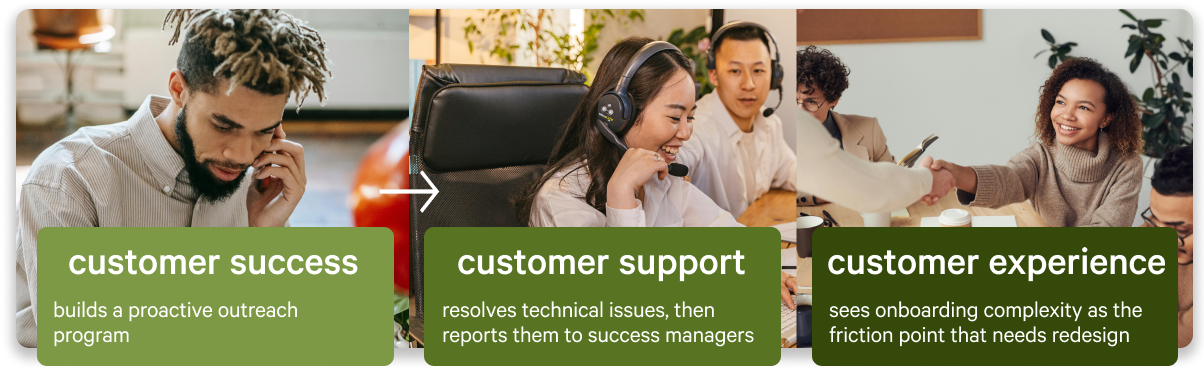
This kind of coordination, where support handles the immediate, success owns the strategic, and CX shapes the systemic, is the gold standard.
At companies that get this right, support and success teams stay connected through shared channels and regular syncs. When a high-stakes issue surfaces, both teams are looped in together: support handles resolution, success follows up to reinforce trust.
How is AI reshaping customer support, success, and CX?
No conversation about customer support, success, or experience in 2026 can ignore the tidal wave of AI adoption reshaping all three.
The global AI customer service market is projected to reach $15.12 billion in 2026, with Gartner estimating up to $80 billion in contact center labor cost reductions by year-end through AI-driven automation. 80% of routine customer interactions are expected to be fully handled by AI, covering ticket categorization, common inquiries, order tracking, and basic troubleshooting.

For customer support, AI is accelerating resolution at a scale humans simply can't match. Conversational AI resolves common and repetitive issues instantly across voice and digital channels, improving contact center efficiency by up to 30% through what Gartner calls “Connected Rep” technology. AI-assisted tools help agents respond faster and with greater accuracy, closing a meaningful gap in first-call resolution rates.
For customer success, AI is enabling the kind of proactive, data-driven intervention that was previously only possible at the largest enterprises. AI can analyze health scores, flag at-risk accounts, surface upsell signals, and personalize outreach at scale, across entire customer bases. 83% of CX leaders say memory-rich AI agents are the key to truly personalized customer journeys, and the data backs this up: personalized, timely interventions directly drive retention.
For customer experience broadly, 78% of organizations expect agentic AI to handle at least half of customer support interactions within 18 months, according to Adobe's 2026 AI and Digital Trends report. The experience aspiration is equally ambitious: 80% of executives want highly personalized real-time experiences, 72% want them seamless across digital and physical touchpoints, and 60% want AI-powered experiences that still feel human and brand-aligned.
Why does human connection still matter in customer support, success, and experience despite AI?
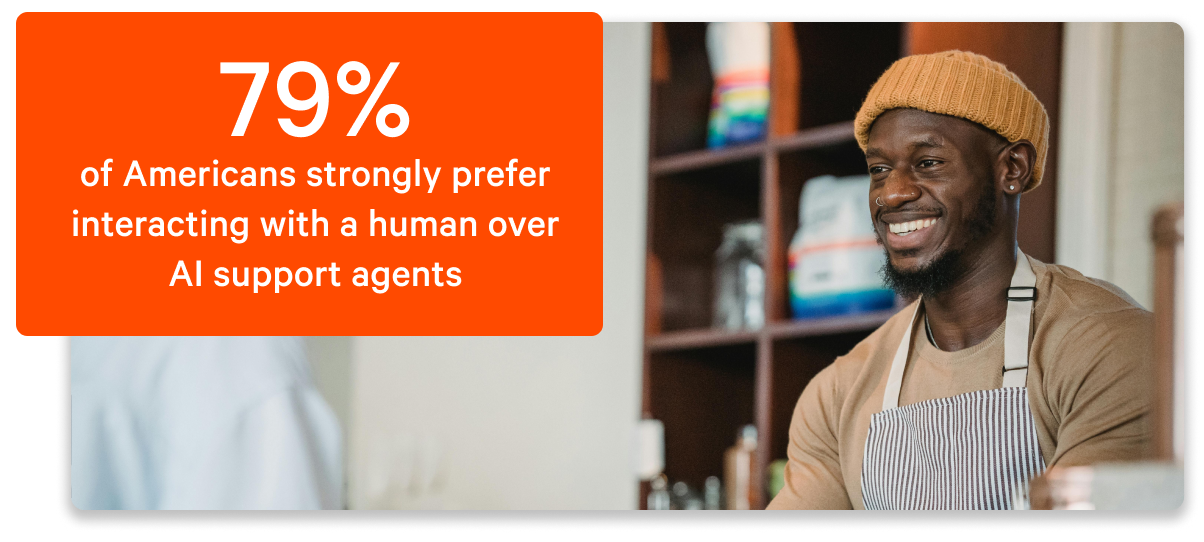
Despite the AI momentum, consumer ambivalence is real. 79% of Americans still strongly prefer interacting with a human over an AI agent. 63% don't believe AI could ever fully replace human beings in customer service. And only 15% of consumers report experiencing a seamless handoff from AI to a human agent, a persistent friction point that degrades the overall experience.
The friction is especially acute in high-stakes moments. 85% of CX leaders say customers will drop brands over unresolved issues, even on first contact. And 95% of customers want to understand why AI makes the decisions it does, a transparency demand that most organizations are woefully unprepared to meet, with only 37% currently offering any reasoning behind AI decisions.
The takeaway for 2026 is not that AI should replace human touchpoints, but that it should free up human capacity for the moments that actually require empathy, judgment, and nuance. AI will deliver the speed customers expect, but human connection will ultimately determine who earns their loyalty.
What should businesses do to structure support, success, and CX in an AI-first world?
Define the lanes clearly. Every organization should have explicit answers to: What does our support team own? What does customer success own? Who owns the broader CX strategy? Without clear ownership, every handoff becomes a gap, and customers feel it.
Invest in integration between teams. Support data should flow into success. Success insights should inform CX strategy. Product feedback collected by both should reach the roadmap. The technology exists to make this seamless; what's often missing is the organizational will to make it happen.
Use AI to augment, not replace, human judgment. The data on AI adoption is clear. It's here and it's accelerating. But 59% of consumers still feel customer experiences are headed in the wrong direction, even as AI investment climbs. The brands that win won't be the ones that automate the most; they'll be the ones that automate intelligently while preserving the human moments that build real loyalty.
Measure differently. Support metrics (response time, resolution rate, CSAT) are not the same as success metrics (NRR, churn rate, adoption depth) or CX metrics (NPS, customer effort score, brand sentiment). Each team needs to be accountable to the KPIs that match its actual function, and leadership needs to understand how they connect.
Personalize at scale, but earn it. 74% of consumers find it frustrating to repeat their story to different agents. Memory-rich AI systems that retain context across interactions are not a luxury anymore. In fact, they're table stakes. But personalization has to be transparent and relevant; experiences that feel manipulative or poorly timed prompt quick disengagement.
Key takeaway
Customer support, customer success, and customer experience are not synonyms. They are distinct functions with different orientations: reactive vs. proactive, transactional vs. relational, individual interaction vs. entire journey. And each comes with different metrics to match.
Customer service resolves issues. Customer success drives progress. Customer experience shapes the emotional relationship between a brand and its customers.
Today, the companies that will outperform aren't necessarily the ones deploying the most AI or hiring the largest support teams. They're the ones that understand how these three functions interlock, invest in making them work together, and never lose sight of the fact that at the end of every ticket, every check-in call, and every brand interaction is a human being deciding whether to stay or leave.
FAQs
Customer support is reactive and solves issues as they arise. Customer success is proactive and focused on driving long‑term outcomes and retention. Customer experience is the overall perception of your brand across every touchpoint, from discovery to renewal and beyond.
Customer support is the “first responder” function that handles bugs, billing issues, and how‑to questions. It is measured with metrics like first response time, average resolution time, first‑contact resolution rate, and customer satisfaction (CSAT).
Customer success is a proactive, relationship‑driven function that helps customers achieve their goals with your product, reduces churn, and drives expansion. Unlike support, which is transactional and ticket-based, success is ongoing and measured with metrics like net revenue retention (NRR), churn rate, product adoption, and upsell or cross‑sell revenue.
Customer experience is the sum of all interactions a customer has with your brand—website, sales, onboarding, product usage, support, and renewals—and how those interactions make them feel. CX is shaped by multiple teams (product, marketing, sales, support, and success) and measured with metrics like Net Promoter Score (NPS), customer effort score (CES), and overall sentiment; no single team can own it in isolation.
AI now automates most routine support interactions, assists human agents, and analyzes usage data to flag at‑risk accounts and upsell opportunities, enabling proactive customer success at scale. Across CX, AI powers more personalized, real‑time journeys, but human connection and transparent handoffs still matter most in high‑stakes moments, where empathy and judgment determine loyalty.
Get started with Influx
Influx was established in 2013 & has been trusted by 750+ brands globally, ranging from startup to scale.
Influx builds 24/7, near-shore global customer support teams. We provide fully managed, flexible & high-performance agents. Our services range from eCommerce support, tech support, sales support, AI Management, Enterprise solutions and more to give you the customer assistance you need to prioritize other responsibilities and continue scaling your business.
Make your support operations fast, flexible, and ready for anything with experienced, 24/7 support teams working on demand. See how brands work with Influx to deliver exceptional customer support or get a quote now.

Read these next
See how companies work with Influx to deliver flexibility and scale.
Or read our client testimonials or case studies
 6 Circle - small.png)