





















Blog > Cx excellence
How to scale CX operations without hiring: a framework for growth-stage brands
Growth-stage brands can scale customer support capacity without growing headcount at the same rate as ticket volume.
The approach rests on three levers, used together rather than in isolation:
- deflecting repetitive contacts before they ever reach a human agent
- distributing the contacts that remain across flexible talent instead of fixed hires, and
- delegating full execution and quality management to an outsourced partner once volume outpaces what a lean internal team can own
Applied in that order, support capacity tracks demand in real time instead of trailing behind a hiring cycle.
That lag is the actual problem. Filling a single customer service seat takes an average of 38 to 40 days even in a fast-moving industry like financial services, according to ContactBabel's benchmarking data. SHRM's broader survey reports a similar finding: average time to fill all roles hovers at 41 days.
But for fast-growing brands, demand can’t wait six weeks. A product launch, a marketing push, or a seasonal spike can double contact volume before a single new hire has cleared onboarding.
Why hiring may not be the best move
Turnover poses a major issue
Annual agent turnover in contact centers runs 40 to 45 percent, and replacing a single agent costs an estimated $10,000 to $20,000 once recruiting, training, and lost productivity are factored in, according to research citing McKinsey & Company's cost analysis.
The U.S. Bureau of Labor Statistics has separately found that call center quit rates run 2-5x higher than almost any other occupation, which means a brand that hires its way to scale is also committing to hiring its way through constant attrition.
Demand for CX is not linear
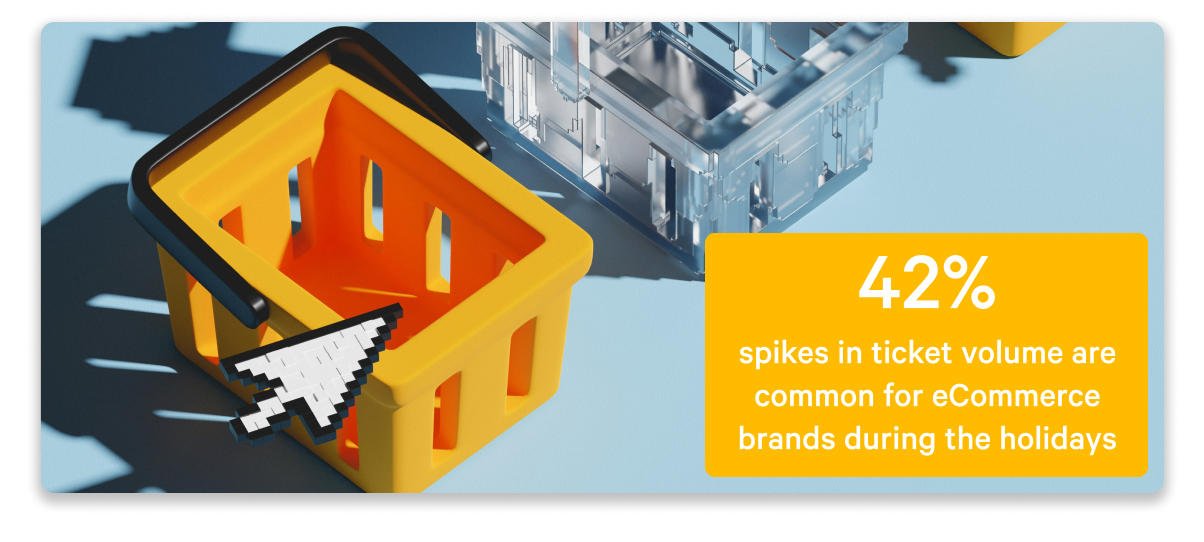
According to research conducted by multiple brands, eCommerce brands can see ticket volumes jump as much as 42% during the holidays. Meanwhile, Shopify's platform data shows a 79% average spike in support tickets in just the first week of December. Hiring permanent staff to cover a six-week peak means paying for idle capacity the other 46 weeks of the year.
Customer expectations keep rising
Zendesk's 2026 CX Trends report found that 88% of consumers now expect faster response times than they did a year ago, and 74% expect service to be available around the clock.
A support org that can only add capacity at the speed of a hiring pipeline is structurally behind that curve before it starts.
None of these factors mean that hiring in-house is wrong. It means hiring should be one lever among several, deployed for the roles that genuinely need permanent, deeply embedded ownership, rather than the default response to every volume increase.

The evaluation criteria behind this framework
The scaling approaches below are compared against five operational criteria, the same ones a CX or ops leader should use when deciding what to reach for next:
- Launch speed: how long from decision to live capacity
- Cost elasticity: how closely spend tracks actual ticket volume, versus sitting fixed regardless of demand
- Quality control mechanism: what actually catches a bad interaction before it becomes a churned customer
- Management overhead: how much of a leader's time the approach consumes on an ongoing basis
- Scalability ceiling: how far the approach can flex before it breaks down
The deflect-distribute-delegate model
Most advice on scaling support treats "add more people" and "add more automation" as competing strategies.
In practice, growth-stage brands that scale well are running three distinct layers at once. The mistake is usually applying the wrong layer to the wrong kind of volume.
Deflect
This layer covers everything that prevents a contact from ever needing an agent: self-service help centers, order-status automation, proactive shipping notifications, and AI-first triage. This makes it worth building early because it’s the cheapest capacity a brand will ever buy. It also deserves more scrutiny than dashboards usually get.
Gartner research shows that while automation can deflect more than 45% of incoming queries, only about 14 percent of those interactions reach genuine self-service resolution. This is a roughly 31-point gap between a contact that never reached a human and a contact that was actually solved.
A brand that only tracks deflection rate, and not resolution rate, can end up hiding a growing backlog of quietly frustrated customers rather than actually removing work from the queue.
Distribute
The distribute layer covers the contacts that still need a person but don't require a permanent hire: cross-trained internal staff, freelancers, seasonal contractors, and sourced part-time or full-time agents managed in-house.
This layer buys flexibility without buying a fixed salary line.
Delegate
The final layer, delegate, covers full outsourcing of execution and management, not just labor. This is the layer growth-stage brands underuse the longest, usually because "outsourcing" gets mentally filed under "cutting corners" rather than "buying operational infrastructure." That framing has been shifting industry-wide.
Deloitte's 2024 Global Outsourcing Survey found that compared to 2020, where cost savings was cited by 70% of executives as the primary driver of outsourcing, as of 2024, only 34% will say savings is the top reason. Instead, they cite reasons including “skilled talent” and “agility” as their main motivation to delegate.
In addition to this, 80% of executives surveyed by Deloitte said they plan to maintain or increase third-party outsourcing investment. The market has grown to match: the global customer experience BPO segment specifically is projected to grow from roughly $102 billion in 2024 to nearly $296 billion by 2033, a 12.8% compound annual growth rate, according to Grand View Research.
6 ways to add CX capacity without adding headcount, ranked

1. Self-service and proactive deflection
Best for: removing repetitive, low-complexity contacts (order status, return windows, account basics) before they generate a ticket at all. Cheapest layer to run once built, but only effective against genuinely simple, well-documented issues.
2. Cross-training the existing team
Best for: very early-stage brands, typically under 500-1,000 tickets a month, where a founder or generalist ops person still touches support directly. Fast and free to start, but breaks down quickly past that volume.
3. Freelance or seasonal contractors
Best for: short, predictable spikes with a clear end date, like Black Friday/Cyber Monday or a single product launch. Fast to bring on, but the brand still owns training, scheduling, and quality assurance.
4. Talent as a service (sourced, client-managed agents)
Best for: brands that want a dedicated agent at a predictable fixed monthly cost while keeping day-to-day management, QA, and workflows in-house. Removes the recruiting burden without removing the management burden.
5. Managed operations (fully outsourced team)
Best for: growth-stage brands where the entire function, including team leadership, quality assurance, and reporting, needs to be absorbed by a partner so internal leadership stops being the bottleneck. Highest scalability ceiling of the flexible-capacity options, since the provider owns scaling the team, not just staffing it.
6. Hybrid model (in-house core plus outsourced overflow)
Best for: more mature CX organizations that want to keep high-context, VIP, or escalation-heavy tickets in-house while routing volume, off-hours coverage, or seasonal overflow to an outside partner. This requires the most coordination but offers the most control.
How the 6 approaches compare
| Approach | Cost | Launch speed | Quality control | Scalability | Management required |
|---|---|---|---|---|---|
| Self-service & deflection | One-time build plus upkeep, no per-contact cost | 2-6 weeks | Content audits, deflection vs. resolution tracking | High for simple queries, near zero for complex ones | Low once live, needs ongoing content upkeep |
| Cross-training existing team | No new cost, but real opportunity cost | Days | Existing manager review | Low, strains past roughly 500-1,000 tickets/month | Medium, adds coordination load to non-support roles |
| Freelance/seasonal contractors | Hourly or per-shift, no benefits | 1-3 weeks to source and onboard | Self-managed, inconsistent without a formal QA process | Medium, suited to short predictable spikes | High, brand owns training, scheduling, and QA |
| Talent as a service | Fixed monthly fee per agent | 1-2 weeks | Brand-managed; provider handles sourcing only | Medium to high, scales agent by agent | Medium, brand still owns QA, coaching, workflows |
| Managed operations | Per-agent monthly fee inclusive of management | About 1 week | Built in (team lead, QA audits, CX reporting) | High, designed to flex with volume | Low, provider owns day-to-day execution |
| Hybrid (in-house + outsourced) | Blended: fixed salaries plus variable outsourced fees | Depends on the outsourced layer, typically 1-2 weeks | Shared: in-house sets standards, partner executes | High, flexes at the margin | Medium, requires cross-team coordination |
When hiring is still the right call
This framework is not an argument against ever hiring. Some roles genuinely benefit from deep, permanent institutional context: a Head of CX shaping strategy, a trust-and-safety specialist handling sensitive escalations, or a first hire in a market where language and cultural nuance are the entire value proposition.
The distinction that matters is between roles that need to accumulate years of embedded judgment and roles that need to execute a well-defined workflow at volume.
The former is worth hiring for even when it's slower and more expensive. The latter is exactly what the deflect, distribute, and delegate layers exist to absorb.
Where outsourcing fits without wrecking your CSAT
The most common objection to the delegate layer is that outsourcing trades cost for quality. That tradeoff is real when a brand hands off execution without also handing off (or retaining) a quality mechanism, but it isn't inherent to outsourcing itself.
The operational levers that actually protect CSAT and first response time (FRT) in an outsourced model are the same ones that protect them in-house: a dedicated team lead who owns performance, structured QA audit scoring rather than spot-checking, and CX reporting that surfaces DSAT drivers and resolution rate by ticket type, not just raw volume handled.
Brands evaluating a delegate-layer partner should ask specifically how each of those three is structured, since "we provide agents" and "we run a quality-managed operation" are very different offers wearing the same label.
A note on providers in the delegate tier
Delegate-layer providers generally split into two models, and it's worth understanding which one a given quote is actually pricing.
Talent-as-a-service pricing typically covers sourcing and a pre-vetted agent, with the brand retaining management, QA, and workflow ownership; at Influx, that runs roughly $1,000 a month for a part-time agent and $1,400 a month full time.
Managed operations pricing covers the sourced agent plus the team lead, QA function, training, and CX reporting layered on top, which is why it costs more per seat; at Influx.com, managed operations starts around $2,000 per agent per month, with new teams typically able to launch in about a week.
Neither model is categorically better. The right one depends on whether a brand's constraint is finding good agents or finding the bandwidth to manage them, and that's worth being honest about before comparing price tags across providers.
Get started with Influx
Influx was established in 2013 & has been trusted by 750+ brands globally, ranging from startup to scale.
Influx builds 24/7, near-shore global customer support teams. We provide fully managed, flexible & high-performance agents. Our services range from eCommerce support, tech support, sales support, AI Management, Enterprise solutions and more to give you the customer assistance you need to prioritize other responsibilities and continue scaling your business.
Make your support operations fast, flexible, and ready for anything with experienced, 24/7 support teams working on demand. See how brands work with Influx to deliver exceptional customer support or get a quote now.

Read these next
See how companies work with Influx to deliver flexibility and scale.
Or read our client testimonials or case studies
 6 Circle - small.png)