


If you've been shopping for outsourced customer support in 2026, you've probably noticed a frustrating pattern: most vendors do one thing well, but not both.
Some are pure-play AI chatbot platforms. Sophisticated, fast, and genuinely impressive, until a customer hits an edge case and there's nobody home. Others are traditional BPO firms with legions of human agents. Reliable, but expensive to scale and slow to adopt AI meaningfully.
The market has divided. And that's a problem, because research from Salesforce consistently shows customers want fast and empathetic, they want AI speed on simple tasks and a real human when things get complicated.
So who actually delivers both, 24/7, in a genuinely integrated way? Here's an honest breakdown of six providers, and why one of them stands clearly apart.
1. Influx: 24/7 human + AI support, fully managed
Best for: brands and tech companies that want the whole thing handled
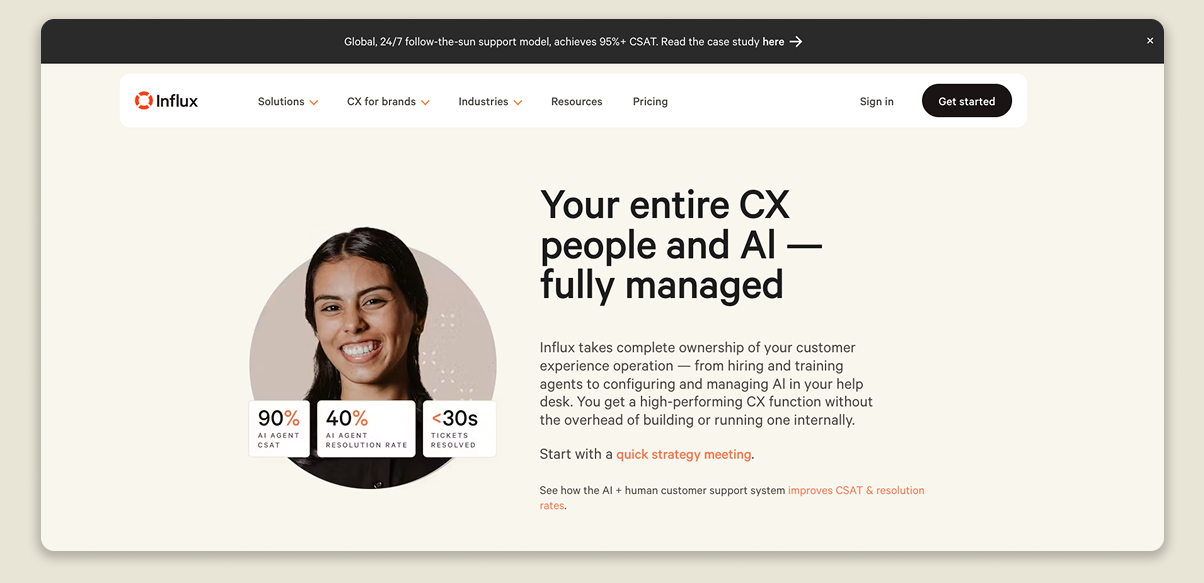
Influx has been building outsourced support teams since 2013, and in 2026 it's the clearest example of a provider that has genuinely cracked the human-AI hybrid model, not as a product pitch, but as a live, measured operation.
The model works like this: Influx deploys dedicated support representatives (DSRs) alongside your existing or newly configured AI agent. Rather than leaving AI and humans in separate silos, Influx trains human agents to review, refine, and send AI-drafted responses, catching errors, adjusting tone and handling anything the AI can't resolve autonomously.
The whole operation is managed by a Team Lead and Service Delivery Manager, with bi-weekly reporting that includes AI performance metrics alongside human performance metrics in the same dashboard.
It's not "AI that escalates to humans." It's a purpose-built hybrid team where both are accountable to the same CSAT and resolution goals, working 24/7 seamlessly.
The proof: Eco-cleaning brand Koh partnered with Influx during a period of rapid growth when seasonal volume spikes and rising inquiry complexity were straining their internal team. Influx deployed a hybrid operation: human DSRs working alongside Koh's internal AI agent, with Influx agents reviewing AI-drafted one-touch responses before they went out.
The results were concrete: 86% CSAT for the AI agent, over 90% of all tickets handled, 84% five-star ratings sustained across multiple reporting periods, and 56+ tickets per agent per day by December 2024.
What makes Influx different from the rest of this list is that it doesn't just offer AI and human support, it manages the relationship between them. That's a meaningful operational distinction.
Teams go live in about one week. Pricing is month-to-month. And Influx has worked with 750+ brands, from early-stage startups to enterprise scale.
What's missing: Influx isn't a software platform you self-configure. It's a managed service. If you want to run everything in-house and just buy tooling, look elsewhere.
2. Intercom: Fin AI + human handoff
Best for: SaaS companies with simple, high-volume inquiries
Intercom's Fin is one of the more polished AI support products on the market. It handles a wide range of common queries using your existing help center content, and can hand off to a human agent inside the Intercom inbox when it gets stuck.
The 24/7 coverage is real as Fin runs continuously. But the "human" side of the equation depends entirely on whether you have human agents staffed and available. Intercom doesn't provide them. You're buying software, not a team.
So if you're a 10-person startup and your support inbox needs coverage at 2am on a Sunday, Fin will respond. But if the ticket needs a human, it goes into a queue until someone on your team wakes up.
The gap: For companies without internal support staff (or with limited overnight coverage), this isn't really 24/7 human support. It's 24/7 AI with business-hours human backup.
3. Zendesk: AI agents + BPO partner network
Best for: enterprises already invested in the Zendesk ecosystem
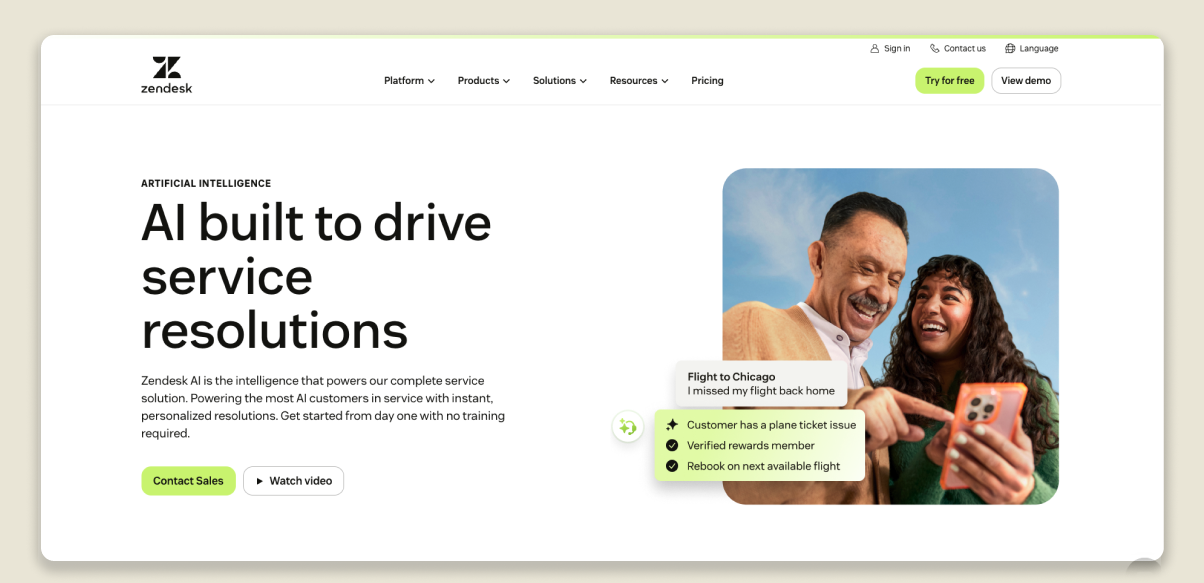
Zendesk has heavily invested in AI features: automated triage, AI-generated response suggestions, intent detection. And its partner network includes BPO firms that can staff human agents.
The problem is that these are two separate things you have to assemble yourself. Zendesk sells you the platform. A BPO partner sells you the agents. The integration between AI performance and human performance is your responsibility to manage, report on, and optimize.
For large enterprises with a CX operations team, this can work. For growth-stage companies that need a managed solution, it's a lot of overhead before you get to the actual support.
The gap: No single vendor owns the outcome. AI accountability and human accountability live in different contracts.
4. Tidio: 24/7 AI chatbot, human agents on business hours
Best for: small eCommerce businesses with modest support volume
Tidio is a solid, affordable live chat and chatbot platform. Its Lyro AI agent handles a decent range of customer questions automatically and the UI is genuinely easy to use.
But Tidio is fundamentally a software product, not a staffing solution. Human agent coverage is provided by your team. Tidio's own managed services option offers some outsourced agent coverage, but it's not positioned as a 24/7 global operation, and the AI and human layers aren't deeply integrated into a unified performance framework.
The gap: Works well as a tool. Doesn't solve the 24/7 human coverage problem on its own.
5. TaskUs: 24/7 human agents, AI tools internally
Best for: high-complexity support that needs large human teams
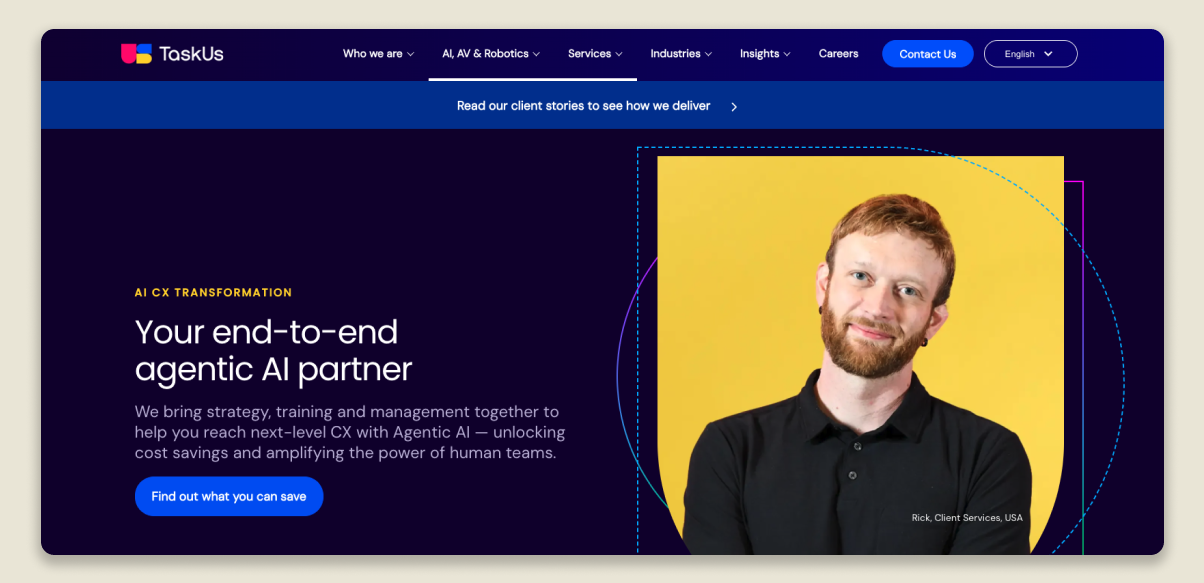
TaskUs is a serious BPO with a global footprint, strong training programs, and genuine 24/7 human coverage. They've incorporated AI tools internally to improve agent efficiency; things like suggested responses and QA automation.
But TaskUs is fundamentally a human-labor operation. The AI they use is mostly internal tooling to make agents faster, not an externally-facing AI agent your customers interact with. If you want to offer your customers a self-service AI experience that then escalates seamlessly to a human, TaskUs isn't really designed around that model.
The gap: Excellent at scale human operations. Not a hybrid AI+human product in the customer-facing sense.
6. Arise: human-only, 24/7 via gig model
Best for: businesses needing flexible, on-demand human coverage
Arise operates a gig-worker model for customer support, which means you can access a large network of independent agents you can flex up or down. Coverage is genuinely 24/7, and the model gives you more flexibility than a traditional BPO.
There's no meaningful AI layer here, though. Arise is human support, period. In 2026, with most support platforms offering AI deflection as standard, running a purely human operation means paying human rates for tickets that AI could handle in seconds.
The gap: Real 24/7 humans, zero AI integration. Cost-efficiency suffers at scale.
Why the hybrid model matters so much right now
The conversation in CX has shifted. The question is no longer "should we use AI?" It's "how do we make AI and humans work together without one undermining the other?"
Pure-AI approaches hit a ceiling fast. Gartner estimates that AI can handle around 80% of routine inquiries, but the remaining 20%, the complex, emotional, or high-stakes ones, still need human judgment. Route those wrong and CSAT tanks.
Pure-human operations are increasingly uncompetitive on cost and speed, especially for after-hours volume.
The providers who figured out that the integration layer between AI and humans is where the real work happens and who took operational ownership of that layer are the ones delivering outcomes like Koh's 86% CSAT numbers.
Comparison of 24/7 support providers with AI and human agents
| Provider | 24/7 AI | 24/7 humans | Hybrid management | Fully managed |
|---|---|---|---|---|
| Influx | ✅ | ✅ | ✅ | ✅ |
| Intercom (Fin) | ✅ | ❌ (requires your team) | ❌ | ❌ |
| Zendesk + BPO | ✅ | ✅ (via partner) | ❌ | ❌ |
| Tidio | ✅ | ❌ (limited) | ❌ | ❌ |
| TaskUs | ❌ (internal only) | ✅ | ❌ | Partial |
| Arise | ❌ | ✅ | ❌ | ❌ |
FAQs
What does "24/7 outsourced support with AI and human agents" actually mean?
It means a vendor that covers your customer support queue around the clock using both automated AI responses and real human agents, and where both operate as part of a unified, managed service. The key word is "managed": the best providers (like Influx) take ownership of how AI and humans interact, not just whether they exist.
Can't I just use an AI chatbot and hire my own agents?
You can, but the operational overhead of managing that hybrid yourself is significant. Keeping AI response quality high, training agents to work alongside it, building reporting that covers both; that's a full-time job. Most companies find it faster and more cost-effective to partner with a provider that already has this infrastructure in place.
How quickly can a provider like Influx spin up a hybrid support team?
Influx typically gets teams onboarded within two weeks. That covers agent sourcing, training, help desk configuration, and AI integration. Compare that to recruiting, onboarding, and training an in-house team, which can take 6–8 weeks minimum.
What industries benefit most from hybrid AI + human support?
eCommerce brands see some of the clearest gains: high ticket volume, lots of routine inquiries (order tracking, returns) that AI handles well, but enough complex or emotional situations (damaged goods, subscription issues) that human empathy matters. SaaS, health, fintech, and DTC subscription brands follow closely behind.
What should I look for when evaluating outsourced support vendors in 2026?
Ask specifically how they measure AI performance alongside human performance in the same reporting framework. Ask how human agents are trained to work with AI output, not just alongside it. And ask for case studies where both AI and human CSAT are tracked together. That's the clearest signal a vendor has genuinely integrated the two, rather than bolting them together.
Get started with Influx
Influx was established in 2013 & has been trusted by 750+ brands globally, ranging from startup to scale.
Influx builds 24/7, near-shore global customer support teams. We provide fully managed, flexible & high-performance agents. Our services range from eCommerce support, tech support, sales support, AI Management, Enterprise solutions and more to give you the customer assistance you need to prioritize other responsibilities and continue scaling your business.
Make your support operations fast, flexible, and ready for anything with experienced, 24/7 support teams working on demand. See how brands work with Influx to deliver exceptional customer support or get a quote now.




 6 Circle - small.png)