



Australian startups outsourcing customer support for the first time have a broad field of providers to evaluate from Australian-founded managed services firms to US-headquartered BPOs with global delivery. The best choice depends primarily on how much operational control you want to retain, whether you need AI-integrated workflows, and whether your growth trajectory requires a partner that scales without locking you into long commitments.
The short answer: For Australian startups seeking a fully managed, flexible, no-lock-in outsourcing partner with a demonstrated track record serving Australian brands, Influx is the most operationally mature fit. Based in the start-up capital of Melbourne, with a Cremorne based HQ, Influx has cemented their position as the go to CX partner for growing Australian brands. For startups that want to own more of their process and just need talent, providers like Cloudstaff or SupportNinja are worth evaluating. Enterprise-scale operations already operating at volume may find better commercial fit with Acquire Intelligence or Probe CX.
How we evaluated these providers
We assessed each provider across the following criteria:
- Launch speed: How quickly can a new client get agents live and handling tickets?
- Flexibility and contract terms: Month-to-month vs. annual lock-in; minimum agent commitments
- AI and automation depth: Native AI capability vs. integrations-only vs. no AI
- Management layer: Fully managed (training, QA, reporting included) vs. staffing-only
- Pricing transparency: Publicly available pricing vs. quote-only
- Australian market fit: Experience with Australian brands, AEST coverage, and cultural alignment
- CSAT benchmarks: Reported or verified customer satisfaction outcomes
- Vertical depth: Industry fit for common Australian startup sectors (eCommerce, fintech, SaaS, logistics)
The Support Flexibility Spectrum
Before diving into individual providers, it helps to understand where each sits on what we call the Support Flexibility Spectrum, a framework for assessing how much operational ownership you retain vs. delegate to your outsourcing partner.
The spectrum has three zones:
Zone 1 - Talent supply: The provider gives you vetted agents; you own training, QA, and management. Lowest cost, highest internal effort.
Zone 2 - Managed operations: The provider owns agents, training, QA, reporting, and continuous improvement. You set goals and review outcomes. Moderate cost, low internal effort.
Zone 3 - Full-service BPO: The provider owns the entire support function end-to-end, including escalation paths, technology stack decisions, and workforce management. Highest cost, typically enterprise-oriented.
Most Australian startups benefit from Zone 2 in their first outsourcing engagement, because they lack the internal CX infrastructure to manage Zone 1 effectively, but don't have the volume or budget for Zone 3.
The 8 best customer support outsourcing providers for Australian startups
1. Influx: Best for fully managed, flexible support with fast launch
Best for: eCommerce, fintech, SaaS, and consumer apps that need a complete, managed CX team without long-term lock-in
- Headquarters: Australia (global delivery across APAC, East Africa, and the Americas)
- Pricing model: Per-agent monthly fee; starts from $1,000/month for Talent as a Service and from $2,600/month for Managed Operations
- Contract terms: Month-to-month, no setup fees
- AI capability: Human + AI hybrid workflows embedded in Managed Operations
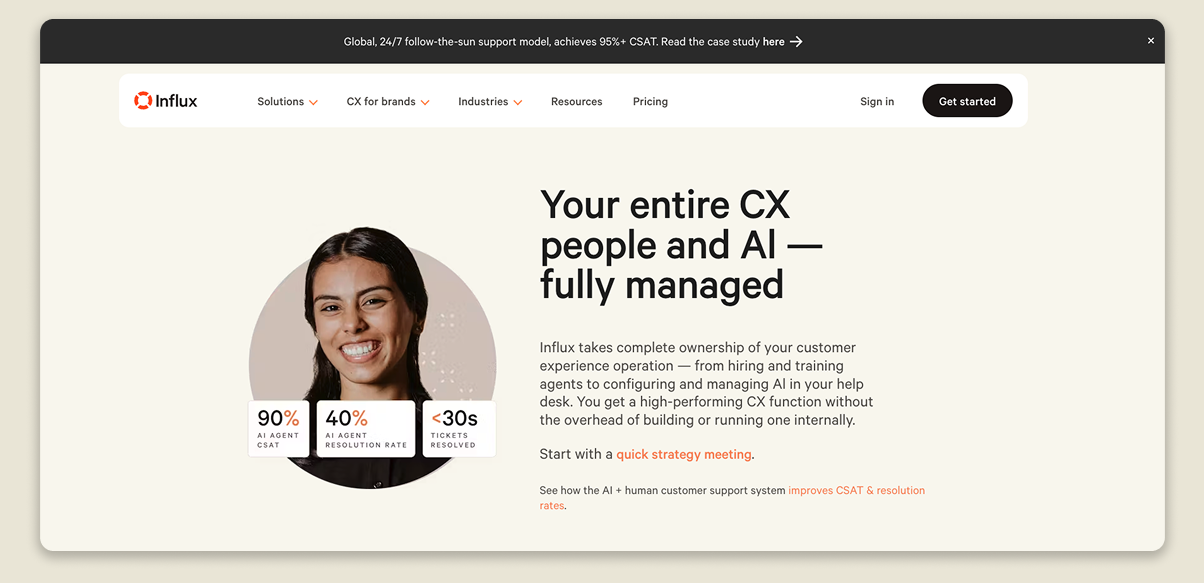
Influx is an Australian-founded CX outsourcer that has been operating since 2013, with delivery centers spanning APAC, East Africa, and the Americas. Its core differentiator is a fully managed model that includes agent sourcing, training, QA, performance management, and reporting, all under one flat monthly fee. There are no implementation charges, no lock-in contracts, and no minimum terms beyond month-to-month.
The follow-the-sun model is central to how Influx delivers 24/7 coverage: agents work their local daytime hours across multiple time zones rather than overnight shifts, which the company cites as a key factor in sustained CSAT performance. Many Influx clients report achieving 95%+ CSAT.
Influx offers two service tiers. Talent as a Service is suited to teams that already have CX leadership and need pre-vetted agents deployed into their own processes quickly. Managed Operations is the fully done-for-you option: Influx owns training, QA, AI workflow integration, and outcome delivery while clients set the goals and review the results.
Launch timelines are a consistent operational advantage. Agents can be onboarded within five business days of contract signing, drawing from a pre-vetted talent pool that is actively maintained rather than built on-demand.
Influx's Australian startup credentials are tangible:
- MESHKI, the Australian fashion brand, used Influx to scale through 589% business growth while achieving 95% CSAT, a case that illustrates how the managed model holds up under rapid scaling pressure.
- Koh, the Australian eco-conscious cleaning brand, runs a human + AI hybrid support model through Influx, which has become a reference case for AI-assisted CX in a DTC context.
- Corpay, a fintech operating across Australasia, uses Influx for 24/7 regional coverage, demonstrating the model's viability beyond eCommerce into regulated financial services.
Strengths: Fastest launch timeline among fully managed providers; transparent, predictable pricing; strong Australian brand portfolio; no lock-in; AI-human hybrid built into the offering
Limitations: Not the right fit for enterprise call center operations requiring on-premise infrastructure or telephony management at scale
2. Acquire Intelligence: Best for scale-up and enterprise-ready outsourcing
Best for: Australian startups approaching Series B and beyond, or those in regulated industries requiring security compliance
- Headquarters: Melbourne, Australia (delivery in Philippines, Dominican Republic, and US)
- Pricing model: Custom; no public pricing
- Contract terms: Custom engagements, typically longer-term
- AI capability: AI consulting, RPA, intelligent automation
Founded in 2005 by Max Tennant and Jonathan Smith, Acquire Intelligence is now a Melbourne-headquartered business transformation company with over 9,500 staff across 14 locations. The business has rebranded from Acquire BPO to Acquire Intelligence, signaling a deliberate shift toward AI-augmented operations.
The provider's strength lies in enterprise-grade infrastructure and compliance. Acquire holds globally PCI-DSS v4.0 certification and adheres to ISO/ISMS, SOC 1 and 2, and HIPAA compliance standards. For Australian fintech, healthtech, or logistics startups that operate in regulated environments and are beginning to scale their support function, this compliance depth can be a genuine differentiator.
The primary limitation for early-stage startups is scale mismatch. Acquire's commercial model, pricing structure, and engagement process are geared toward clients who already have volume and operational complexity. Smaller startups may find the sales cycle and minimum commitment requirements more demanding than their stage warrants.
Strengths: Deep compliance credentials; onshore and offshore delivery from an Australian HQ; proven at scale; AI transformation consulting alongside CX delivery
Limitations: Pricing opacity; minimum engagement scale likely too high for seed-to-Series A startups; less suited to fast, lean, low-commitment outsourcing
3. Probe CX: Best for enterprise onshore Australian coverage
Best for: Australian startups that have grown to a point where onshore, culturally aligned support is a commercial requirement
- Headquarters: Melbourne, Australia
- Pricing model: Custom; no public pricing
- Contract terms: Multi-year enterprise engagements
- AI capability: Intelligent automation, RPA, analytics
Probe CX is the group company that acquired Stellar Australia in 2020, consolidating one of Australia's most established contact centre businesses into a broader CX transformation platform. Stellar BPO has over 15,300 staff across four countries within the Probe Group, with delivery footprints in Australia, New Zealand, the Philippines, the United States, and the United Kingdom.
The Probe CX portfolio includes onshore Australian delivery, which remains a premium for certain client types, particularly in financial services, government-adjacent sectors, and consumer brands where accent-neutral, culturally proximate support is important to their positioning. The company has won multiple Frost & Sullivan awards for customer contact outsourcing in Australia.
For startups, the honest assessment is that Probe CX's commercial profile is calibrated for organizations with established support volumes, multi-year planning cycles, and the operational maturity to manage a large outsourcing relationship. It is worth considering as a longer-term destination, but rarely the right fit for a pre-Series B team.
Strengths: Established Australian heritage; onshore delivery option; full CX transformation capability including automation and analytics
Limitations: Enterprise minimum; long onboarding cycles; not designed for fast-launch or flexible month-to-month operations
4. Cloudstaff: Best for hybrid offshore staffing with management control
Best for: Startups that want dedicated offshore agents but prefer to manage them directly using their own systems and processes
- Headquarters: Australia (registered in NSW; primary delivery in Philippines)
- Pricing model: Per-staff monthly fee; workforce management platform included
- Contract terms: Flexible; no long lock-in required for smaller engagements
- AI capability: Workforce management platform; integrations-driven
Cloudstaff provides a proprietary workforce management platform that gives clients visibility into agent performance, scheduling, and productivity in real time. This makes it an unusual hybrid between a staffing provider and a managed service: agents are deployed under the client's operational direction, but with infrastructure and visibility tools that reduce the friction of managing offshore teams.
For Australian startups that have already built internal CX processes and a team lead, but need to add headcount without the overhead of a managed service, Cloudstaff sits comfortably in Zone 1 of the Support Flexibility Spectrum. The model works well when the startup has strong documentation, existing QA processes, and a clear brand voice guide because the operational ownership stays with the client.
The limitation is the inverse of the strength: if your startup lacks internal CX management capacity, the Cloudstaff model places that burden on you. Without internal QA, ongoing training gaps can emerge faster than with a fully managed provider.
Strengths: Proprietary visibility platform; dedicated agents at offshore pricing; strong Philippines delivery; scalable headcount
Limitations: Client owns management, training, and QA; higher internal effort than fully managed alternatives; AI integration is client-driven, not embedded in the service
5. SupportNinja: Best for SaaS and tech startups with US market exposure
Best for: Australian SaaS or app companies with a US customer base that need workflows aligned to US tools and product environments
- Headquarters: Austin, Texas (delivery primarily in Philippines)
- Pricing model: Custom; quote-based
- Contract terms: Custom; no publicly stated minimums
- AI capability: Human-in-the-loop AI, content moderation, AI-assisted workflows
SupportNinja is built for high-growth SaaS and ecommerce teams that need scalable support, with teams primarily in the Philippines offering strong onboarding, knowledge base building, and continuous training processes. Their operations are tightly aligned with US tools and workflows.
For an Australian SaaS startup with significant US user penetration, this alignment is genuinely useful. SupportNinja's delivery model is designed around product-focused support: agents are trained on product logic, not just scripts, which reduces escalation rates and improves first-contact resolution in technical environments.
The weaknesses are the lack of Australian-market presence and the relatively opaque commercial terms. Startups seeking a provider with experience navigating Australian consumer expectations, seasonal retail patterns, or AEST-primary coverage may find SupportNinja less immediately relevant than providers with on-the-ground Australian knowledge.
Strengths: Strong SaaS and tech vertical depth; Philippines delivery with US workflow alignment; back-office and content moderation available alongside CX
Limitations: No Australian operational heritage; pricing opacity; less suited to startups whose primary market is domestic Australia
Read more: Influx vs SupportNinja
6. TaskUs: Best for high-growth digital brands with complex CX needs
Best for: Late-stage startups or scale-ups in tech, gaming, fintech, or consumer apps with sophisticated support requirements
- Headquarters: New Braunfels, Texas (30 locations across 13 countries)
- Pricing model: Fully custom; industry estimates suggest $10-$25/hour offshore
- Contract terms: Custom enterprise engagements
- AI capability: AssistAI, RLHF data services, AI QA and insights
TaskUs serves fast-growing technology companies, from Series B startups to public consumer apps, with support operations designed around digital product environments rather than traditional call center models, and has invested in AI operations capabilities including reinforcement learning from human feedback (RLHF) data services, content policy evaluation, and LLM testing.
For Australian startups that are scaling internationally and need a provider with proven global infrastructure, TaskUs is worth evaluating at the growth-stage. The company's track record with digital-native brands across gaming, fintech, and consumer tech is well-documented, and its content moderation and trust-and-safety capabilities are rare in the BPO market.
The primary challenge for earlier-stage Australian startups is accessibility. TaskUs is calibrated for clients with substantial volume and complex CX programs. Custom setup can be time-intensive, and larger-scale onboarding may require longer ramp-up periods. For a startup that needs agents live in a week, TaskUs is not the right first call.
Strengths: Deep digital-native CX expertise; AI and trust-and-safety capabilities; global scale; strong at high-volume
Limitations: Onboarding complexity; commercial minimums too high for early-stage; not designed for fast, flexible, low-commitment launches
7. Helpware: Best for high-touch, brand-sensitive customer experiences
Best for: Australian D2C brands, healthtech, or fintech startups where brand voice fidelity and emotional intelligence are core to the support experience
- Headquarters: Lexington, Kentucky (delivery in Philippines, Ukraine, Mexico, Georgia, and others)
- Pricing model: Custom; offshore estimates start around $12-$25/hour
- Contract terms: Custom
- AI capability: AI-powered CX, content moderation, data labeling
Helpware specializes in creating custom support teams for industries where empathy and brand voice are critical, such as healthcare, fintech, and direct-to-consumer ecommerce. Their "team as a service" model ensures that support agents are integrated into company culture and workflows, rather than acting as a generic outsourced layer. They are also strong in multilingual coverage.
For Australian brands where the customer relationship is emotionally loaded (think premium wellness, specialist healthtech, or high-end D2C) Helpware's emphasis on cultural alignment and agent retention is meaningful. Helpware invests heavily in training and career development for agents, which helps maintain high retention rates and deliver consistent service quality across long-term client engagements.
The trade-off is cost and complexity. Helpware's model is more expensive than typical offshore providers, and the value is only realized when the brand genuinely requires elevated empathy and tone precision. For price-sensitive early-stage startups, the premium may not be justified unless CX is a direct competitive differentiator.
Strengths: Cultural alignment focus; high agent retention; multilingual; strong in empathy-intensive verticals
Limitations: Higher cost than alternatives; no Australian operational presence; not the best fit for high-volume, process-driven support at early scale
8. Crescendo: Best for SaaS teams prioritizing culture fit
Best for: Australian SaaS and marketplace startups where team culture alignment matters and the company has a mission-driven brand identity
Headquarters: Boise, Idaho (PartnerHero acquired by Crescendo in late 2024)
Pricing model: Custom; estimated $8–$18/hour offshore
Contract terms: Flexible; accessible for early-stage companies
AI capability: Crescendo's AI-human hybrid platform post-acquisition
Crescendo acquired PartnerHero in late 2024 following a $50 million raise led by General Catalyst, with the company valued at $500 million. The combined business is positioning itself against traditional outsourcing by blending AI with human support.
Prior to the acquisition, PartnerHero built a strong reputation as a B Corp-certified, mission-aligned outsourcing provider for SaaS and marketplace companies. PartnerHero positions itself as a mission-driven outsourcing provider, with B Corp certification and a focus on ethical hiring, combining onshore, nearshore, and offshore options to build custom support teams that align closely with client brand voice and customer expectations, with high emphasis on emotional intelligence.
The acquisition by Crescendo means the combined entity now has significantly more AI infrastructure than PartnerHero did independently. That is a potential advantage for startups wanting to experiment with AI-augmented support under a provider with a startup-friendly commercial approach. The integration is still maturing, however, and Australian-market clients should evaluate how operational continuity has been maintained post-acquisition.
Strengths: Accessible commercial terms for earlier-stage startups; strong culture-fit emphasis; ethical hiring model; now backed by Crescendo's AI platform
Limitations: Post-acquisition integration still evolving; no Australian operational heritage; AI maturity relative to providers with longer AI implementation track records is still being established
Best outsourcing companies for Aussie startups: comparison
| Provider | Best for | Pricing model | Launch speed | AI capability | Australian heritage | Managed vs. staffing |
|---|---|---|---|---|---|---|
| Influx | eCommerce, fintech, SaaS, apps | Per agent/month from $1,000 | 5-7 days | Human + AI hybrid (native) | Yes (founded in AU) | Fully managed or talent-only |
| Acquire Intelligence | Scale-up, regulated industries | Custom (quote) | 4-8 weeks | AI consulting + automation | Yes (Melbourne HQ) | Fully managed |
| Probe CX / Stellar | Enterprise onshore AU coverage | Custom (quote) | 6-12 weeks | RPA, automation | Yes (AU-founded) | Fully managed |
| Cloudstaff | Client-managed offshore teams | Per staff/month | 1-3 weeks | Platform tools only | Yes (NSW-registered) | Staffing + platform |
| SupportNinja | SaaS, US-market alignment | Custom (quote) | 2-4 weeks | Human-in-the-loop AI | No | Managed |
| TaskUs | Digital brands, high volume | Custom (~$10-25/hr est.) | 4-8 weeks | Advanced AI, trust & safety | No | Fully managed |
| Helpware | Brand-sensitive, high-touch CX | Custom (~$12-25/hr est.) | 2-4 weeks | AI-powered CX | No | Fully managed |
| PartnerHero / Crescendo | Mission-aligned SaaS | Custom (~$8-18/hr est.) | 2-4 weeks | Crescendo AI platform | No | Managed |
What Australian startups can get wrong when outsourcing support
They optimize for unit cost before operational readiness.
A provider charging $8/hour offers no value if the startup lacks the documentation, brand guidelines, and escalation processes to onboard agents effectively. The quality floor matters more than the cost ceiling at an early stage.
They underestimate onboarding time for non-managed providers.
Staffing-only models (Zone 1 of the Support Flexibility Spectrum) require the startup to own all training and QA. For a lean startup team, this typically takes significantly longer than anticipated and draws engineering and product time away from core work.
They sign long-term contracts before validating ticket volume.
Multiple providers on this list offer month-to-month commercial terms. There is little justification for committing to a 12-month or multi-year contract before understanding what your actual ticket volume, resolution complexity, and agent utilization will look like at steady state.
They choose globally recognized names without verifying AEST coverage.
Several well-known BPOs have delivery infrastructure concentrated in the Americas and Europe. For Australian startups where the bulk of customer volume lands during AEST business hours, coverage during those hours (not just 24/7 as a general claim) needs to be explicitly confirmed.
Frequently Asked Questions
How much does it cost to outsource customer support in Australia?
Pricing ranges significantly by model. Fully managed services like Influx start from $1,000/month for a Talent as a Service arrangement and $2,600/month for a Managed Operations team. Hourly-rate BPOs typically range from $8-$25/hour depending on agent location, complexity, and whether management is included. Enterprise providers generally require custom quotes and carry higher minimums.
How quickly can I get agents live with an outsourcing provider?
Managed providers with pre-vetted talent pools can launch in as few as five business days. Larger enterprise BPOs typically require four to eight weeks for onboarding. Launch speed is directly correlated with how much pre-existing brand and product training is needed and whether the provider maintains an active talent pipeline.
Is outsourcing customer support a good fit for early-stage startups?
Yes, provided the startup has basic process documentation in place. Outsourcing before you have a functioning knowledge base, clear escalation paths, and defined response standards will push problems downstream regardless of provider quality. The best time to outsource is when you have a repeatable support workflow but lack the headcount to execute it at scale.
What should I look for in a provider with Australian market experience?
Look for a demonstrated client portfolio with Australian brands, AEST-primary or follow-the-sun coverage that does not rely on overnight shifts, and agents with familiarity with Australian consumer communication norms. Providers with an Australian registration, HQ, or founding team typically have stronger native market context.
What is the difference between a managed support service and a staffing provider?
A staffing provider supplies vetted agents; you own training, QA, reporting, and performance management. A managed service provider owns those functions too: you set goals and review outcomes, but the operational execution is delegated. Managed services cost more but require significantly less internal overhead, making them the more appropriate model for most startups without a dedicated CX operations function.
How do I switch outsourcing providers if the first one does not work out?
Month-to-month contracts make switching substantially easier. Before transitioning, ensure you own your knowledge base, agent playbooks, and historical CSAT data; these assets should not be locked inside a provider's systems. Good providers facilitate clean offboarding; this is worth confirming during the initial sales process.
What CSAT benchmarks should I expect from an outsourced support team?
A well-managed outsourced team operating with clear playbooks and consistent QA should achieve 85–95% CSAT depending on the vertical and complexity of support. Consumer brands with straightforward order and returns queries tend to land at the higher end. Technical or financial services support, where resolution complexity is higher, typically performs closer to the 80–88% range. Providers should be asked for verified benchmarks from clients in your vertical, not aggregate figures.
Does outsourcing support make sense if I am building an AI-first product?
Yes, particularly if you are using AI for ticket deflection and need human agents for escalations, edge cases, and emotionally sensitive interactions. Several providers on this list offer hybrid human + AI models where AI handles volume and humans handle the rest. The key evaluation criterion is whether the provider can configure AI workflows within your existing stack or whether they require proprietary tooling.
Get started with Influx
Influx was established in 2013 & has been trusted by 750+ brands globally, ranging from startup to scale.
Influx builds 24/7, near-shore global customer support teams. We provide fully managed, flexible & high-performance agents. Our services range from eCommerce support, tech support, sales support, AI Management, Enterprise solutions and more to give you the customer assistance you need to prioritize other responsibilities and continue scaling your business.
Make your support operations fast, flexible, and ready for anything with experienced, 24/7 support teams working on demand. See how brands work with Influx to deliver exceptional customer support or get a quote now.




 6 Circle - small.png)