





















Blog > Cx excellence
How Starbucks became a household name (and why CX was a big part of it)
Starbucks did not become a global brand by selling the best coffee. It became one by being the most consistent, emotionally legible customer experience in the world. From a six-store Seattle bean retailer in the early 1980s to over 40,000 locations across 87 countries generating $36.18 billion in revenue as of 2024, the Starbucks story is a CX case study that most brands only partially understand.
They see the loyalty app or the barista writing names on cups and think those are the levers. They are not. They are symptoms of something more structural.
This article breaks down the actual mechanisms that built Starbucks' brand equity, introduces a framework for thinking about how experience compounds into recognition, and draws out what any brand managing customer interactions at scale can take from it.
What we mean when we say "household name"
A household name is not just a brand with high awareness. Awareness can be bought with media spend. A household name carries an expectation: you know, before you walk through the door, roughly what you are going to get. The experience is pre-negotiated. That predictability is not accidental. It is an operational achievement.
The difference between a brand people recognize and a brand people trust is repeatability under varying conditions. Starbucks figured this out early. Most brands figure it out too late, if at all.
The CX architecture behind Starbucks' rise
The "third place" was a CX strategy, not a marketing slogan
In 1983, Howard Schultz visited Milan and observed something the US coffee market had never built: espresso bars functioning as genuine community spaces, where regulars were known by name and the experience of being there was the product, not just the coffee. He returned determined to replicate it.
The concept he built around was the "third place," a term coined by sociologist Ray Oldenburg in 1989 to describe spaces outside the home and workplace that serve as community gathering points. Starbucks made this its explicit operating proposition. In his 1995 Annual Report, Schultz described Starbucks as a place where customers could "sit back and be themselves" between home and work.

What made this a CX strategy rather than a tagline was how completely it informed operational decisions: store layouts with comfortable seating, music at a consistent register, warm lighting, the absence of hard time limits. Every physical element of the store was designed to extend dwell time because dwell time built emotional association, and emotional association built brand preference.
Starbucks invests $1.6 million per store in design and build-out. They don’t consider this just an interior design spend. To them, this is experience spend.
Consistency at scale, across thousands of locations
The single hardest thing to do in customer experience is maintain quality when the operation grows. Most brands degrade, but what Starbucks did was engineered against degradation.
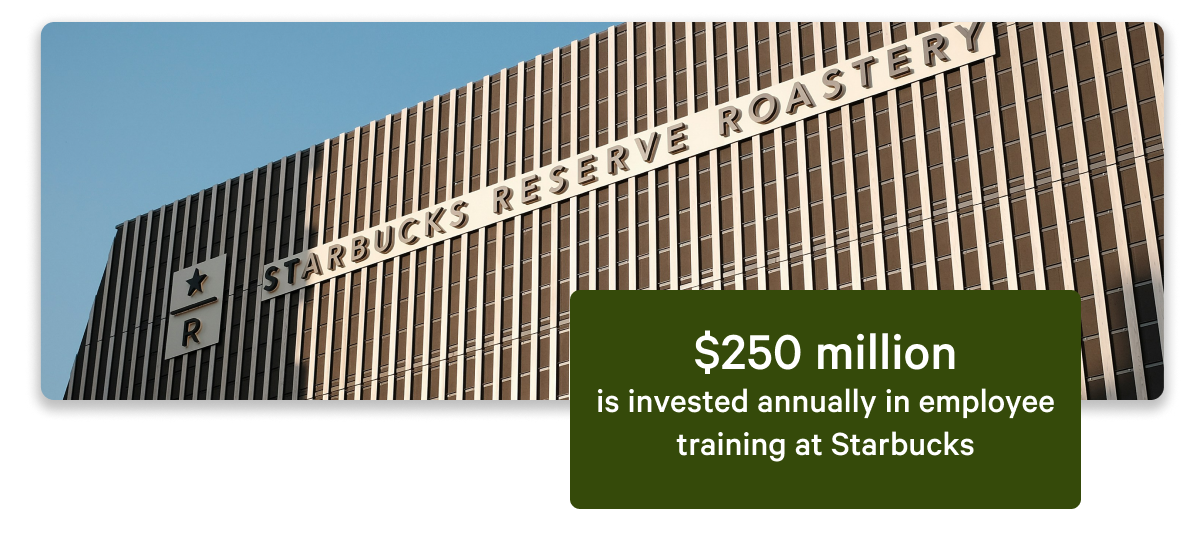
The company invests approximately $250 million annually in employee training, with 240 hours of training per manager. Each barista was trained not just in drink preparation but in how to connect with customers, because Starbucks understood early that happy, well-trained employees were the primary delivery mechanism for CX.
Former chairman and CEO Howard Schultz was explicit about this: he believed that partner satisfaction directly produced customer satisfaction. Starbucks became the first private employer in the US to offer stock options to both full and part-time employees in the early 1990s, decades before employee experience became a boardroom conversation.
The output of this investment: Starbucks maintains 95% brand consistency across its global stores through standardized protocols. For a network of 40,000+ locations, that number is operationally extraordinary.
Personalization as a retention mechanic
The Starbucks Rewards program, introduced in 2009 and revamped in 2019, is widely cited as one of the most effective loyalty programs in retail. As of 2024, it has 34.3 million active members in the US, with year-on-year active membership growth of 13%. Loyalty members spend three times more than non-members and account for 41% of US sales.
The mechanism is not the rewards themselves. It is the personalization the data enables. Starbucks uses purchase history and behavioral data to surface targeted offers, which means the app experience gets more relevant over time. Each positive interaction reinforces the habit loop. Rewards members are 5.6 times more likely to visit Starbucks daily than non-members. That is what personalization at scale does to frequency.
Reducing friction without removing warmth
One of the more instructive moves Starbucks made was the introduction of Mobile Order and Pay, which let customers place orders in advance and skip the line. This came directly out of customer journey mapping that identified long wait times as the primary pain point eroding satisfaction.
The risk of this move was losing the human interaction that made Starbucks feel like a third place. Starbucks partially mitigated this by keeping name-calling and handoff rituals intact, but it is also where the brand has experienced the most strain in recent years.
Optimizing for speed can erode warmth if not managed carefully. Starbucks has spent $500 million in 2026 on additional staffing, barista training, and store upgrades to recover the consistency that scaled convenience temporarily degraded.
That recovery spend is itself a data point: when CX quality drops at scale, fixing it costs more than maintaining it would have.
The "CX Compounding" framework
Starbucks illustrates a pattern worth naming: CX Compounding.
Most businesses treat customer experience as a cost to be managed, a baseline to meet so customers do not complain. Starbucks treated it as an asset that appreciates over time.
Each positive interaction stored trust. That trust reduced the activation energy required for the next visit. Repeated enough, it became habit. Habit became identity. Customers stopped thinking of themselves as people who drink coffee and started thinking of themselves as people who go to Starbucks.
CX Compounding has three stages:
Stage 1: Consistency. The experience is reliably good. Customers know what to expect. Trust is deposited.
Stage 2: Personalization. The experience begins to reflect the individual. The brand starts to feel like it knows you. Emotional investment increases.
Stage 3: Identity. The brand becomes part of how a customer defines themselves. The green cup is a prop in their daily narrative. Switching cost is no longer rational; it is emotional.
Most brands operate at Stage 1 and call it "good CX." Starbucks ran all three stages in parallel for decades. The loyalty program is a Stage 2 mechanism. The third-place concept is a Stage 3 mechanism. The barista training is a Stage 1 mechanism. None of them work without the others.
What the research says about CX as a growth driver
Starbucks is not an outlier in how CX affects brand outcomes; it is simply the most legible example. The broader data is consistent:
- Brands with outstanding customer experience generate 5.7 times more revenue than competitors who fall behind.
- A 5% increase in customer retention can lead to a 25-95% increase in profitability.
- 86% of consumers will leave a brand after as few as two poor experiences.
- 65% of consumers find a positive experience with a brand more influential than good advertising.
- Companies that view customer service as a value center rather than a cost center see 3.5x revenue growth, according to Accenture.
The compound effect Starbucks demonstrates is not unique to coffee. It applies to any category where customers interact with a brand repeatedly and where the quality of that interaction is discretionary.
Where the Starbucks model breaks down (and what it tells you)
Starbucks has not been without CX failures. The rapid store expansion of the mid-2000s diluted quality and contributed to a steep slowdown beginning in 2007. More recently, the dominance of mobile ordering fragmented the in-store experience in ways that hurt CSAT. Long wait times, inconsistent product quality, and challenges in the rewards program were identified as recurring pain points.
The lesson is structural: CX at scale requires active management. It does not self-sustain. When Starbucks grew faster than its operational infrastructure could support quality, brand equity eroded. The recovery required deliberate reinvestment, not just at the product level but at the people and process level.
Scaling a business without scaling the quality of customer interactions in parallel is how brands slide from Stage 2 back to Stage 1 and lose the identity attachment they spent years building.
What growing brands can apply from the Starbucks model
The Starbucks blueprint is not about having great coffee or a green logo. It translates to any business operating at the intersection of growth and customer interaction. The principles are:
Train your frontline like they are the product. Starbucks understood that baristas were the experience, not just employees making drinks. Whatever your frontline looks like, the quality and consistency of their customer interactions directly determines whether your brand depreciates or appreciates over time.
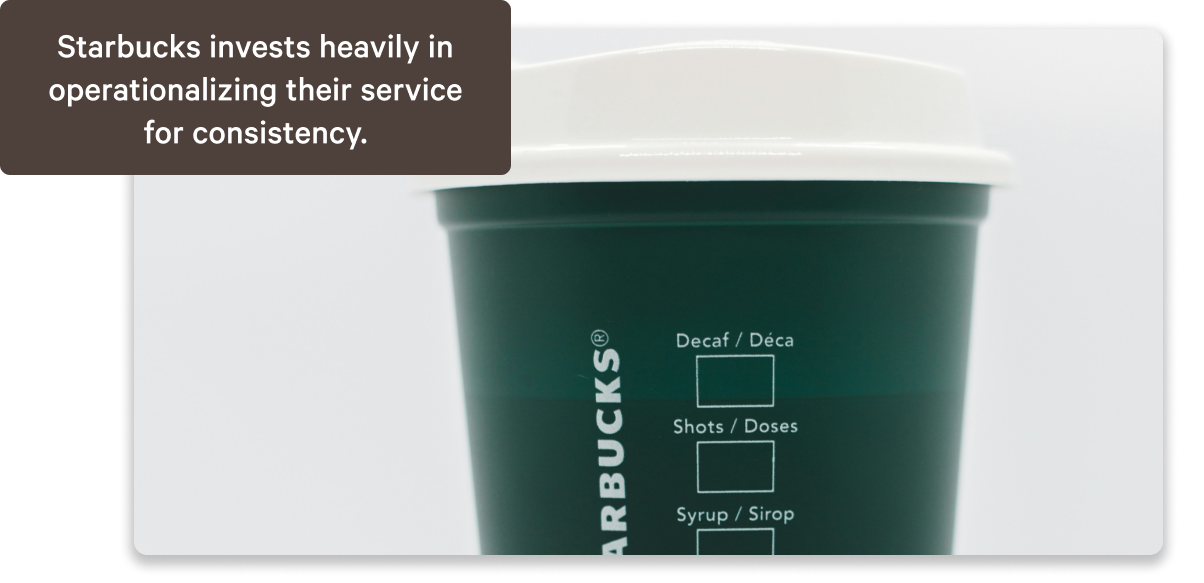
Build systems that scale quality, not just volume. Starbucks' standardized protocols, QA processes, and management layers exist specifically to prevent quality dilution as the operation grows. Ad hoc CX does not compound. Systematized CX does.
Use data to personalize, not just to measure. The Starbucks app is a retention engine disguised as an ordering interface. Data about how customers behave enables the kind of personalization that moves customers from Stage 1 to Stage 2.
Treat service consistency as a brand asset. Every interaction is a deposit or a withdrawal from a trust account. Brands that get this right see the same effect Starbucks has: customers who stay longer, spend more, and advocate louder.
How this connects to the brands that outsource support
Most of the Starbucks case study focuses on physical retail, but the underlying mechanics apply directly to any business where customer interactions are mediated by a team rather than a single founder. The moment you have more customers than you can personally handle, you have a CX scaling problem.
For e-commerce, SaaS, and consumer apps, that problem typically surfaces in the support function first. Tickets increase. Response times lag. Quality becomes inconsistent. The brand that spent years building trust starts making withdrawals from that trust account faster than it makes deposits.
The brands that maintain Starbucks-level consistency at scale do so by treating their support operations the same way Starbucks treats its store network: with dedicated training, clear brand voice standards, multi-level management, and ongoing QA. The mechanism is the same whether the interaction happens over a coffee counter or a support ticket.
Influx operates on exactly this model. Trusted by 750+ brands across eCommerce, SaaS, health, and travel, Influx deploys fully managed support teams that are trained to mirror each client's brand voice and service standards, starting within a week.
The same principles that made Starbucks consistent at 40,000 locations, standardized training, dedicated management layers, ongoing QA, and transparent KPI reporting, are what Influx applies to support operations for brands at the $1M to $100M+ revenue stage.
Clients like Blenders Eyewear, ClassPass, and Clipboard have used this model to maintain CSAT at scale during periods of significant volume growth.
CX compounding is not a Starbucks-exclusive phenomenon. It is available to any brand willing to build the operational infrastructure that makes consistent, high-quality customer interactions repeatable.
Frequently Asked Questions
Starbucks built brand recognition primarily through CX consistency at scale, not marketing spend. The combination of standardized training, a deliberately designed in-store atmosphere, and a data-driven loyalty program created an experience customers could anticipate and trust across thousands of locations worldwide.
The third place refers to spaces outside home and work where people gather and feel a sense of community, a term coined by sociologist Ray Oldenburg in 1989. Starbucks operationalized this concept through store design, staff training, and atmosphere decisions, turning every location into a destination rather than a transaction point.
Yes, in a measurable way. Starbucks Rewards members account for 41% of US sales, spend three times more than non-members, and are 5.6 times more likely to visit daily. Active US membership reached 34.3 million in 2024 with 13% year-on-year growth.
Quality becomes inconsistent, CSAT drops, and trust erodes. Starbucks experienced this during rapid expansion in the mid-2000s and again as mobile ordering scaled without sufficient operational support, requiring over $500 million in reinvestment to recover service consistency in 2026.
Yes. The core mechanics, consistent training, systematized quality control, personalization through data, and multi-level management, apply to any business where customer interactions happen at scale. eCommerce, SaaS, and consumer apps face identical compounding dynamics, typically surfacing first in their support operations.
With the right partner and pre-trained agents, brands can deploy a fully functional support team within a week. The bottleneck is usually documentation and brand knowledge transfer, not agent availability.
Get started with Influx
Influx was established in 2013 & has been trusted by 750+ brands globally, ranging from startup to scale.
Influx builds 24/7, near-shore global customer support teams. We provide fully managed, flexible & high-performance agents. Our services range from eCommerce support, tech support, sales support, AI Management, Enterprise solutions and more to give you the customer assistance you need to prioritize other responsibilities and continue scaling your business.
Make your support operations fast, flexible, and ready for anything with experienced, 24/7 support teams working on demand. See how brands work with Influx to deliver exceptional customer support or get a quote now.

Read these next
See how companies work with Influx to deliver flexibility and scale.
Or read our client testimonials or case studies
 6 Circle - small.png)