





















Blog > Cx excellence
7 reasons why everyone loves IKEA (and what it teaches us about CX)
There's a particular kind of person who goes to IKEA for one bookshelf and leaves two hours later with a trolley full of scented candles, a set of wine glasses, and a plate of meatballs they didn't plan to eat. Nearly all of us are that person.
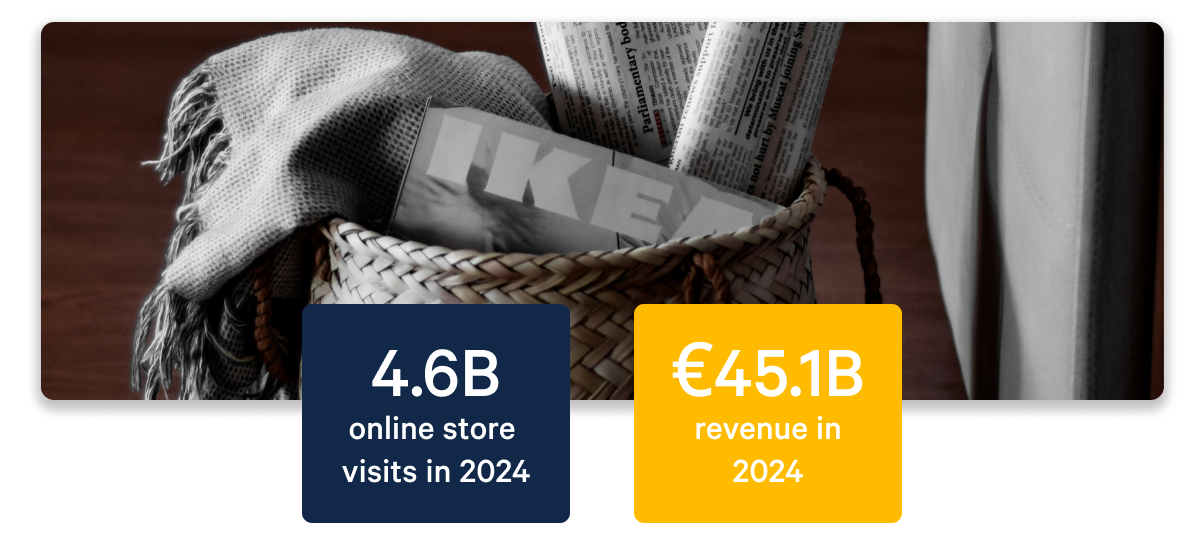
IKEA stores welcomed 915 million visitors in 2025 alone, the fifth consecutive year of growth, and IKEA.com clocked approximately 4.6 billion visits in 2024. For a furniture retailer, those are extraordinary numbers.
So what exactly is IKEA doing that keeps people coming back, and what can the rest of us learn from it, especially about improving the customer experience?
1. It makes good design accessible to everyone
Before IKEA, stylish home furnishings were largely a luxury. Founder Ingvar Kamprad's core belief was simple: good design shouldn't be reserved for the wealthy.
The flat-pack model, or furniture shipped in compact boxes and assembled at home, slashed manufacturing and shipping costs without compromising on aesthetics.
The result is a catalogue of genuinely good-looking products at prices that don't require a second mortgage. IKEA's annual revenue grew from €10.4 billion in 2001 to €45.1 billion in 2024, a trajectory that proves design democratization is not just noble, it's enormously profitable.
2. The store layout is practically psychological engineering
Have you ever noticed you can't take a shortcut through an IKEA? That's intentional.
Stores are typically designed in a one-way layout, leading customers counter-clockwise along what IKEA calls "the long natural way," designed to encourage customers to see the store in its entirety.
Along the way, shoppers pass through fully styled room displays: a studio apartment, a teenager's bedroom, a minimalist kitchen, all to spark imagination and desire.
It's retail storytelling. You don't just browse products; you inhabit a lifestyle. And it works, because people consistently spend far longer in IKEA than they intended to.
3. The meatballs are genuinely part of the strategy
This one sounds like a joke, but it isn't. IKEA's food operation is a serious business. One billion meatballs are sold and served in IKEA stores globally every year, and the food business saw a turnover of 2.15 billion euros, with 93% of customers saying they would recommend IKEA food products to their friends.
But the really clever part: the food was never purely about revenue. As one IKEA food executive put it, meatballs are "the best sofa-seller," because it's hard to do business with hungry customers.
When you feed them, they stay longer, talk about their potential purchases, and make a decision without leaving the store. Food is a customer experience tool disguised as a menu item.
4. It's built a world-class loyalty community
IKEA launched a loyalty card called "IKEA Family," which is free of charge and can be used to obtain discounts on certain products found in-store. It’s available worldwide. But loyalty at IKEA goes deeper than a discount card.
The brand has cultivated a cultural identity; IKEA lovers share assembly hacks on social media, debate the merits of BILLY vs KALLAX, and feel a sense of ownership over the products they've literally built with their own hands.
That's the "IKEA effect" at work: people ascribe higher value to things they've assembled themselves, creating an emotional investment that a pre-assembled piece of furniture simply can't replicate.
The brand has cracked the code on creating a customer loyalty program without it feeling forced on consumers to participate.
5. It treats sustainability as a feature, not a footnote
Today's customers, especially younger ones, want to buy from brands whose values align with their own. IKEA has made sustainability a pillar of the business rather than an afterthought.
IKEA's ambition is that by 2030, all plastic used in its products will be based on renewable or recycled material. Meanwhile, IKEA Group has set a science-based target to cut the climate impact of stores and other operations by 80% in absolute terms by 2030 compared to 2016.
These aren't vague pledges, either. They're specific, time-bound commitments that customers can hold the company accountable to. When a brand makes sustainability tangible, it earns trust.

6. It localizes brilliantly without losing its identity
IKEA operates in 63 countries and has mastered the art of being globally consistent while locally relevant.
In Japan, store displays are adapted to resemble realistic Japanese apartment rooms rather than European layouts. In China, stores are positioned close to public transport rather than on city outskirts, because fewer customers own cars. In India, close to 20% more visitors come in to grab a bite rather than browse for home décor, so IKEA leans into its food offering there more heavily.
The brand knows what it stands for, but it's humble enough to listen to local customers. That balance is rare and valuable.
7. Its prices make the decision easy
Affordability is not the same as cheapness. IKEA has spent decades engineering its supply chain so that cost savings get passed to the customer rather than absorbed as margin.
IKEA's strategy remains to launch new products at lower recommended retail prices than existing ones. This is likely a trend that will continue in the years ahead.
When customers feel like they're getting genuine value and not just low prices on low-quality goods, they return. Price confidence is its own form of customer loyalty.
What does all of this have to do with customer experience?
Everything.
IKEA's enduring popularity isn't really about furniture. It's about how the brand makes people feel at every single touchpoint: walking through the store, eating in the restaurant, assembling a wardrobe at midnight, or returning a product with no fuss.
The brand has obsessively engineered the customer journey from the parking lot to the checkout, and it shows in those 915 million annual store visits.
The lesson for any business is this: customers don't just remember what they bought, they remember how they were treated, how easy it was, and whether the experience matched the promise. Great customer experience isn't a department. It's a strategy.
That's where Influx comes in. Influx helps brands deliver consistently excellent customer support: fast, flexible, and on brand, so that every interaction your customers have with your team feels as considered as an IKEA room display.
Whether you need to scale for a seasonal surge, launch a new support channel, or simply clear a backlog and start fresh, Influx gives you a team that's ready to go without the long lead times or long-term lock-ins. Because in a world where customers have endless options, the experience you deliver is often the only thing that sets you apart.
Get started with Influx
Influx was established in 2013 & has been trusted by 750+ brands globally, ranging from startup to scale.
Influx builds 24/7, near-shore global customer support teams. We provide fully managed, flexible & high-performance agents. Our services range from eCommerce support, tech support, sales support, AI Management, Enterprise solutions and more to give you the customer assistance you need to prioritize other responsibilities and continue scaling your business.
Make your support operations fast, flexible, and ready for anything with experienced, 24/7 support teams working on demand. See how brands work with Influx to deliver exceptional customer support or get a quote now.

Read these next
See how companies work with Influx to deliver flexibility and scale.
Or read our client testimonials or case studies
 6 Circle - small.png)