



Both Influx and TalentPop promise to take the weight of customer support off your plate. Both are month-to-month, both claim top-tier agents, and both have real brands singing their praises. So what actually separates them
Quite a bit, it turns out. Here's a category-by-category breakdown of how these two outsourced support solutions stack up, and where one clearly pulls ahead.
Industry breadth
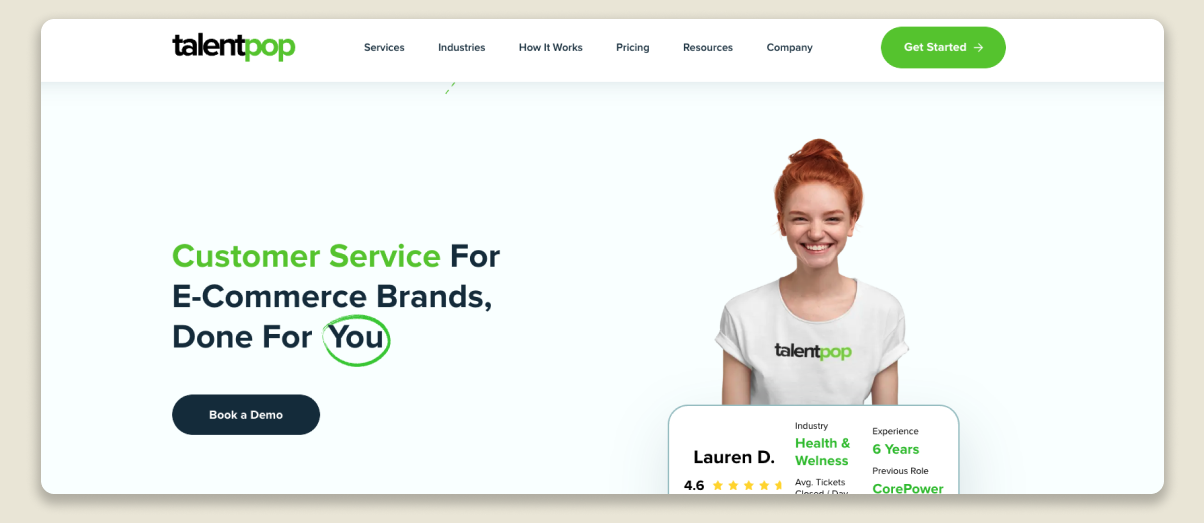
TalentPop was built specifically for eCommerce. It's a specialized outsourced customer support solution trusted by over 500 leading eCommerce brands, providing custom recruitment of dedicated agents trained to deliver on-brand, eCommerce-specific service.
That focus is genuinely valuable if you're running a Shopify store, but it becomes a ceiling the moment your needs go beyond it.
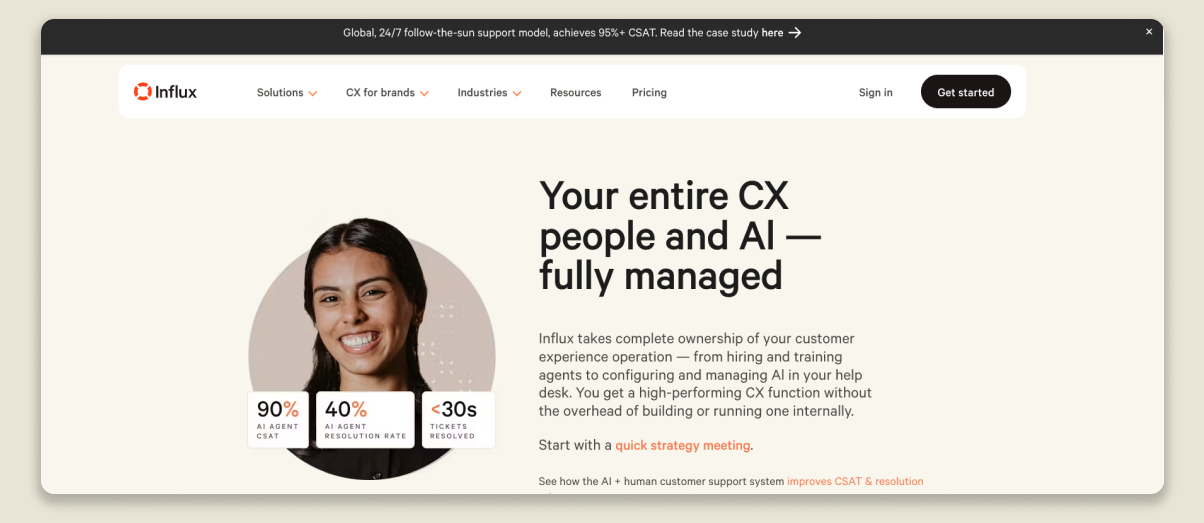
Influx, on the other hand, provides fully-managed teams across eCommerce, SaaS, fintech, health and wellness, logistics, travel, mobile apps, EdTech, hospitality, and more.
What this means is Influx doesn’t just give you ad hoc agents. Your brand can fully offload the task of ongoing training and performance management. This is because Influx operates on an outcomes-based model, not a cost-per-agent model, making sure excellence is the CX standard.
Just some of Influx’s clients include Clipboard (healthcare service), ClassPass (consumer tech), Sendle (business service), 99designs (design marketplace), and Meshki (eCommerce), a deliberately cross-industry portfolio.
If your business doesn't fit neatly into a DTC box, or you want a partner who can grow with you as your model evolves, Influx's breadth is a meaningful advantage.
Winner: Influx. TalentPop excels for pure eCommerce; Influx covers far more ground with fully managed teams, layered with AI Management and diverse industry expertise.
Pricing structure
TalentPop charges hourly. Their professional plan, the most popular, runs $12/hour per agent for 1-9 agents working 40 hours per week, with a one-time $500 staffing fee per agent.
At 40 hours a week, that's roughly $1,920 per agent per month before the staffing fee. Scale to 10-24 agents and the rate drops to $10/hour; 25+ agents gets you down to $8/hour.
Influx uses a transparent per-agent monthly fee with no setup costs or hidden charges. You pay one clear price per agent per month based on their location and hours. And that's it.
This eliminates the pricing complexity common in outsourcing where vendors add charges for implementation, training, system access, or management overhead after the initial quote.
TalentPop's hourly billing means your costs fluctuate week to week based on hours tracked, and you absorb the $500 per-agent staffing fee upfront. Influx's fixed monthly model makes budgeting genuinely predictable; you know your number before the month starts.
Winner: Influx with its predictable monthly pricing with no setup fees beats hourly billing with per-agent staffing costs.
Speed to launch
This one isn't even close. TalentPop says it takes on average 2-3 weeks to get agents up and running, including recruitment, onboarding, and live training.
Influx maintains a pre-vetted global talent pool, which means agents are ready before you sign. You get trained agents handling your customers within 5 business days of contract signing.
That's not just a sales claim, either; it's the direct result of how Influx recruits. The company builds its talent pipeline continuously rather than starting a search after you commit.
For any team dealing with a sudden volume spike, a seasonal surge, or a backlog that's already out of control, the difference between 5 days and 3 weeks is enormous.
Winner: Influx because its 5-day deployment is a fundamentally different operational capability than 2-3 weeks.
Management structure
TalentPop provides a Customer Success Manager, a Team Lead, and an Onboarding Specialist per agent. That's a solid setup for getting an agent embedded in your brand's workflow.
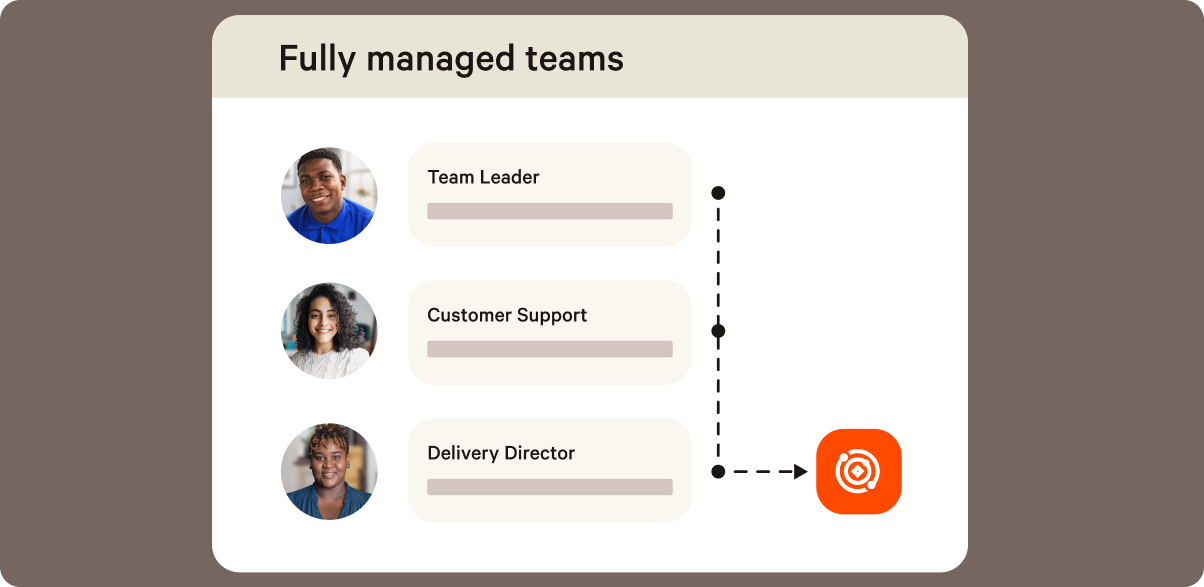
Influx runs a three-tier management structure: a local manager who handles day-to-day performance, a brand-specific CX manager who keeps agents trained on your product and voice, and data-driven oversight at the portfolio level for continuous improvement.
Every team also has a dedicated Team Lead responsible for KPI optimization and escalation strategy.
This isn't just an org chart difference. It means performance improvement happens autonomously, and you don't need to push for it. Issues get caught before they become patterns. And when you scale, the management layer scales with you without creating gaps.
Winner: Influx. Its three-tier management architecture is more robust and designed for scale.
24/7 coverage
Both platforms offer 24/7 coverage. But how they deliver it is very different.
Influx uses what’s called a "follow-the-sun" model: agents in Indonesia, Kenya, Jamaica, and other locations work during their local daytime hours. No overnight shifts, anywhere.
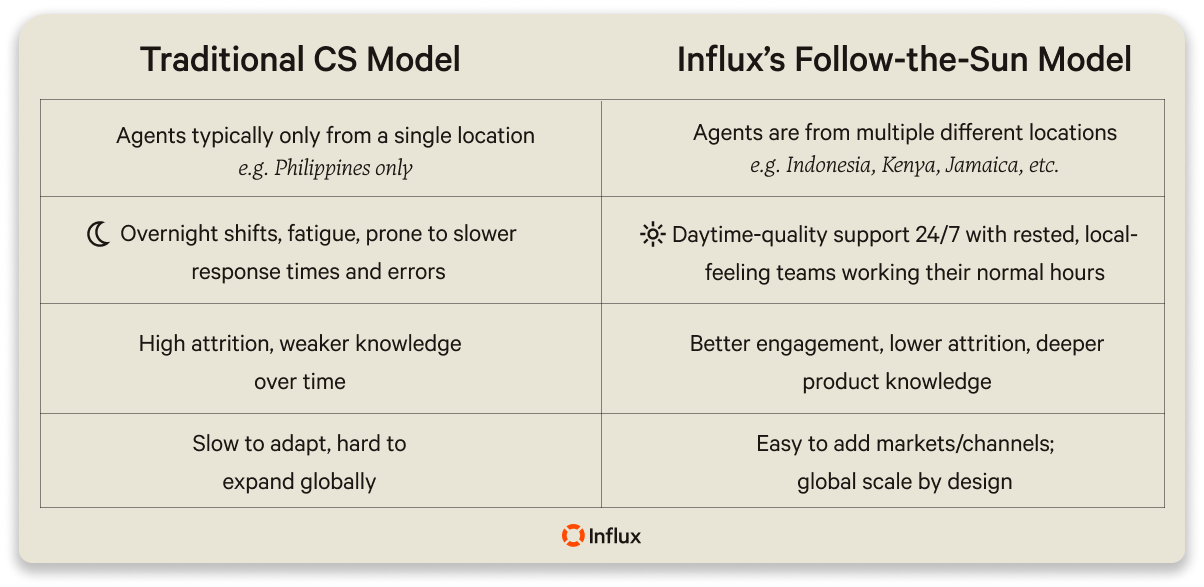
This is for good reason: research has shown that night shifts produce 11-33% slower response times and 15-25% higher error rates, alongside data showing 83% of permanent night shift workers experience sleep disorders.
What does this mean for your startup then? Daytime agents in overlapping time zones consistently outperform any model that puts agents on graveyard shifts.
TalentPop operates globally across time zones but doesn't articulate a comparable framework for how they specifically protect service quality during off-hours coverage.
Winner: Influx. The follow-the-sun model is grounded in research and has real quality implications.
Brand training and knowledge transfer
TalentPop puts agents through roughly 20 hours of initial training covering Shopify, eCommerce best practices, customer support protocols, and your brand's historical inquiries. They also record live training calls for future reference, which is a smart operational detail.
Influx's onboarding goes further in a different direction. They transform your existing knowledge base into structured, actionable playbooks, and here's the part brands often don't expect: you retain full ownership of those playbooks.
Many clients report the refined playbooks are more useful than their original internal documentation. Influx also sets up a "Slack Bridge" so you can talk directly to your dedicated client captain, ops manager, or individual agents from your own Slack workspace. That level of direct access to the team handling your customers is unusual.
On an ongoing basis, Influx uses API access to your helpdesk to learn from previous conversations, and the QA team uses that data to give agents regular feedback.
Winner: Influx because its playbook ownership, Slack Bridge access, and helpdesk-integrated QA create a more durable knowledge transfer system.
AI integration
TalentPop's AI automation resolves 30-50% of routine tickets (things like order status queries), freeing agents to focus on complex issues. Their AI Transformation plan starts with a $2,500 setup fee, then adds hourly charges for an AI Success Manager ($200/hour), an AI Implementation Specialist ($80/hour), and a QA Specialist ($15/hour). Those costs stack up quickly.
Influx has built human + AI support teams as a native offering, not a bolt-on product line. AI management is a part of the core service model, which means you get more than just “an AI answers some tickets sometimes” level of service, all with one predictable monthly price and no lock-in periods.
Winner: Influx.
Proven results at scale
TalentPop has strong social proof within eCommerce. Hello Molly handled 90,000+ tickets in 2023 with just four agents. Vega achieved a 92.8% CSAT score across 12,000 tickets.
Influx's documented results cover a wider range of scale: Blenders Eyewear achieved 94% CSAT during a 20,000-ticket seasonal surge; ClassPass resolved over 250,000 tickets in a single month with 76 agents; Meshki hit 95% CSAT while supporting 589% business growth.
These aren't just big numbers. They demonstrate that Influx has been stress-tested at enterprise scale, not just SMB volume.
Winner: Tie. Both have proven results in their industries.
Influx vs TalentPop summary
| Category | Influx | TalentPop |
|---|---|---|
| Industry coverage | Broad (eCommerce, SaaS, fintech, health, travel, logistics, and more) | Primarily eCommerce/DTC |
| Pricing model | Fixed monthly per-agent fee, no setup costs | Hourly billing + $500/agent staffing fee |
| Time to launch | As fast as 5 business days | 2-3 weeks on average |
| Management layers | Three-tier (local, brand-specific, data-driven) | Customer Success Manager + Team Lead |
| 24/7 coverage approach | Follow-the-sun model (daytime agents only) | Global time zones, no stated framework |
| Brand training | Playbook creation (client retains ownership) + Slack Bridge | ~20 hours initial training + recorded calls |
| AI integration | Native, included in core service model | Add-on with $2,500 setup + hourly fees |
| Scale of proven results | Up to 250,000+ tickets/month | Up to ~90,000 tickets/year with small teams |
| Contract terms | Month-to-month, no lock-in | Month-to-month, no lock-in |
| Partner count | 750+ | 700+ |
Frequently Asked Questions
What is the main difference between Influx and TalentPop?
The biggest difference is scope and depth. TalentPop is purpose-built for eCommerce brands and charges hourly with a per-agent staffing fee. Influx serves a broader range of industries, charges a flat monthly per-agent fee with no setup costs, and can have trained agents live within 5 business days, compared to TalentPop's 2-3 week average.
Is Influx or TalentPop better for eCommerce brands?
TalentPop has strong brand recognition in the eCommerce space, but Influx works with major eCommerce brands like Blenders Eyewear and Meshki and has documented results at significantly higher ticket volumes. For brands that are scaling fast or operating across multiple channels, Influx's multi-tier management structure and follow-the-sun model make it the stronger choice.
Does Influx charge setup fees?
No. Influx uses a simple per-agent monthly fee that includes everything: training, management, QA, and ongoing support. There are no implementation fees, setup fees, or hidden charges. TalentPop charges a one-time $500 staffing fee per agent, plus additional costs if you want AI transformation services.
How quickly can Influx launch a support team?
Influx can have trained agents handling tickets within 5 business days of contract signing for standard support roles. This is possible because they maintain a continuously updated pool of pre-vetted talent rather than starting recruitment after a client signs.
Which platform handles high-volume or enterprise-level support better?
Influx. Their largest documented case study shows 76 agents resolving over 250,000 tickets in a single month. They also maintained 94% CSAT during a 20,000-ticket seasonal surge and 1-hour response times during 3x volume peaks. TalentPop's strongest public results are at a meaningfully smaller scale.
Get started with Influx
Influx was established in 2013 & has been trusted by 750+ brands globally, ranging from startup to scale.
Influx builds 24/7, near-shore global customer support teams. We provide fully managed, flexible & high-performance agents. Our services range from eCommerce support, tech support, sales support, AI Management, Enterprise solutions and more to give you the customer assistance you need to prioritize other responsibilities and continue scaling your business.
Make your support operations fast, flexible, and ready for anything with experienced, 24/7 support teams working on demand. See how brands work with Influx to deliver exceptional customer support or get a quote now.


94% CSAT across 6 different brands under 1 unified CX solution

76 agents resolve 250,000+ tickets per month with 24/7 coverage, surpassing KPIs

Clipboard Health's app hits unicorn status with Influx.com providing an elastic, 24/7 operational layer

Meshki supports 589% business growth with ethical near-shore service model & achieves 95% CSAT

Melinda Maria delivers boutique 5-star jewelry support with a flexible, brand-first Influx team

Under 2 min. first response time and 95% CSAT

CX success - Koh leverages both Human + AI agents to achieve 86% CSAT
 6 Circle - small.png)