




Blog > Inside influx
What “top 1% talent,” follow-the-sun, and fully managed support really mean for your business
Over 1,000 people, spread across 123 cities and 15 countries, doing customer support for some of the fastest-growing brands in the world. Fully remote. No central office. No single time zone the rest of the business orbits around.
That setup raises an obvious question for any founder considering working with Influx: how does a team that distributed actually hold together?
It's worth understanding, because the answer is a lot of what makes the model work.
Hired from everywhere, for a reason
Influx interviews a large pool of candidates for every role and only brings on the top 1%. The global footprint is what makes that possible. Recruiting across 15 countries means the hiring bar stays high because the pool is genuinely wide. It also means agents are embedded in the regions they serve rather than consolidated into a single hub and asked to cover markets on the other side of the world at odd hours.
The agents who make it through tend to be comfortable operating in complexity. One client had their Influx team working across five separate platforms simultaneously, maintaining over 20 ticket responses per agent per day throughout a period when weekly volume climbed from 3,500 tickets to over 5,000. The headcount scaled. The output standard didn't. That kind of performance starts with who gets hired, and it shows up in what your customers experience on the other end.
A management layer that actually manages
The question most founders ask before they start is some version of: will they actually sound like us? It makes sense. You've spent years building a brand voice, a customer relationship, a standard for how things should feel. The idea of handing that to a team you've never met is uncomfortable, even when the numbers stack up.
For most clients, that concern dissolves quickly once performance data starts coming in. For one brand, a 10/10 client satisfaction score followed within weeks of go-live, after a situation where digital case ages had been running at over 14 hours. For another brand working with Influx through a period of rapid growth, CSAT held above 90% while the business grew by 589% and its internal support workload dropped by 85%. The brand didn't dilute. It scaled.
But results like that don't come from people alone. They come from a management structure built to sustain them.
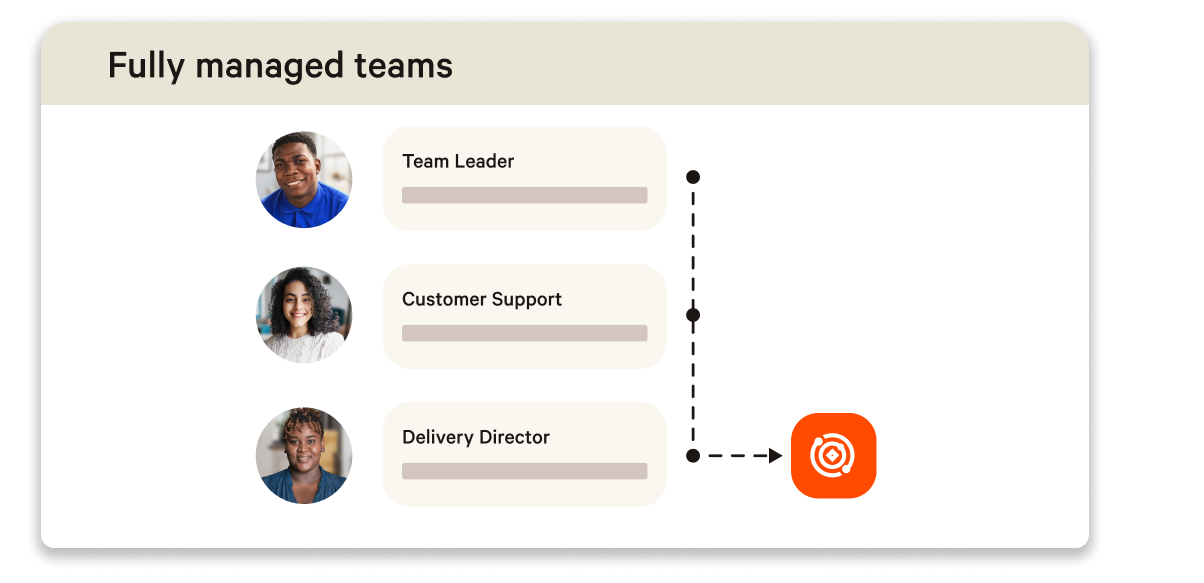
Every Influx team operates with a dedicated leadership layer: team leaders, QA oversight, brand documentation, and clear systems for SOPs and internal communication. As your volume grows, that structure grows with it. When one brand's ticket load climbed sharply over several months, additional team leaders came in at each stage to maintain oversight as headcount grew. The management capability expanded in step with the team, not after the fact.
Follow the sun, and what it means for the people in it
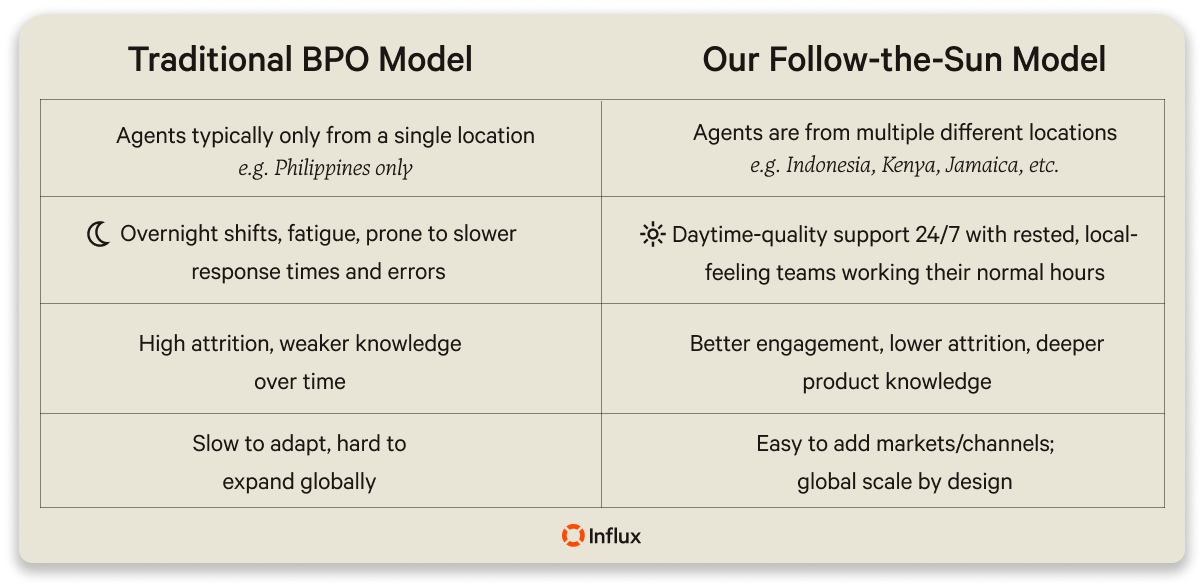
The follow the sun model is how Influx builds 24/7 coverage without burning anyone out. Rather than routing everything through one location, teams are built across multiple regions. Agents work regular hours where they live, fully remote, with a team leader online in the same time zone.
For your customers, the effect is seamless coverage regardless of when they reach out. A midnight message gets the same quality of response as one sent at noon. If you're running a late-night drop or an early-morning launch, there's already a team online because it's a regular working day somewhere.
The practical impact can be significant. One brand moved from average case ages of over 14 hours to under 9, within weeks of switching to this model. Not by adding more people, but by having the right people online at the right time, with someone in the same region accountable for the outcome.
Club 90 and the standard underneath the standard
Influx runs an internal performance and recognition program called Club 90. The name is the benchmark: 90% of agents and team leaders must hit 90% SLA compliance, every single day. Each week, performance is tracked against QA scores, first response times, handle times, and attendance. The people consistently hitting the mark receive bonuses, public recognition, and a clear pathway into the Influx Leadership Program, which is how management roles get filled rather than through external hiring.
That last part matters more than it might seem. The team leaders running Influx client accounts have in many cases come up through the same system the agents are working in now. There's a visible path, and people are invested in it. When a team hits a milestone or a particularly strong week, it gets celebrated, and that culture of recognition comes through even in a fully remote environment where it would be easy for wins to go unnoticed.
The retention effect is real and measurable. Influx's attrition rate runs up to 50% below industry average. For your brand, that continuity is worth more than it might seem at first. The team working with you in month twelve has spent a year learning your tone, your edge cases, the customers who need a different approach. That knowledge accumulates, and it shows.
It's also why the phrase clients use most often, across industries, is that the Influx team feels indistinguishable from their own.
What client first looks like in practice
Influx's stated values are the kind of thing that sounds obvious written down: the Golden Rule, honesty delivered with kindness, following through on what you say you'll do. The one that tends to show up most visibly from the outside is continuous improvement, and it doesn't always look the way you'd expect.
One global payments company came to Influx for customer support. In the process of embedding with the team, Influx identified a problem the client hadn't flagged: the internal sales team was spending so much time on application administration and chasing paperwork that new applications were being delayed by over a month. Influx introduced a dedicated role to own that process end-to-end, handling outbound follow-ups, documentation, and the handoff between customers, sales, and operations. The pipeline unblocked almost immediately. That wasn't in the brief. It was just the right thing to do.
For founders weighing the decision, the pattern among those who've made the move is consistent: the risk is lower than expected, and the upside is larger. The ones who have regrets, generally, chose the wrong partner.
If you're thinking about what it could look like for your brand, the best place to start is seeing how it's worked for others. Read the case studies, or get in touch to talk through what your team could look like.
Frequently Asked Questions
What is the follow-the-sun model?
The follow-the-sun model is a way of building support teams across multiple time zones so that agents are always working regular hours in their own region. Rather than one centralized team covering all hours, Influx builds localized teams with managers in each region, so 24/7 coverage happens naturally across the working day rather than through overnight shifts. For your customers, support is always on. For the agents delivering it, the hours are sustainable.
What does "top 1% of candidates" actually mean?
It means Influx interviews a large pool of applicants for every role and hires only the top 1% from that pool. The selection is based on the ability to operate accurately across complex systems, maintain high output targets, and handle nuanced brand interactions. Because Influx recruits across 15+ countries, the candidate pool is wide enough to hold that bar consistently.
What is Club 90?
Club 90 is Influx's internal performance and recognition program. The standard it sets: 90% of agents and team leaders must hit 90% SLA compliance every day. Performance is tracked weekly against QA scores, response times, handle times, and attendance. Top performers receive bonuses, public recognition, and a pathway into Influx's Leadership Program. It's also a significant driver of retention—Influx's attrition rate runs up to 50% below industry average.
How does Influx manage quality across a fully remote team?
Through a dedicated management layer that's built into every team. That means team leaders, QA oversight, brand documentation, and shared systems for SOPs and internal communication. As a team scales, the leadership structure scales with it. Agents aren't operating without backup or oversight—the management layer is part of what's delivered.
How quickly will an Influx team learn my brand?
Influx documents brand voice and trains agents before go-live, and because the same agents work with a brand consistently, that knowledge builds over time rather than resetting. Most clients find the adjustment period shorter than expected. The concern about brand fit tends to be the first thing that goes once a team is up and running.
Get started with Influx
Influx was established in 2013 & has been trusted by 750+ brands globally, ranging from startup to scale.
Influx builds 24/7, near-shore global customer support teams. We provide fully managed, flexible & high-performance agents. Our services range from eCommerce support, tech support, sales support, AI Management, Enterprise solutions and more to give you the customer assistance you need to prioritize other responsibilities and continue scaling your business.
Make your support operations fast, flexible, and ready for anything with experienced, 24/7 support teams working on demand. See how brands work with Influx to deliver exceptional customer support or get a quote now.



 6 Circle - small.png)