





















There's a difference between brands people use and brands people love. You can see it in how customers talk (or don't talk) about a company after something goes wrong. You see it in whether someone recommends you to a friend with genuine enthusiasm or with a cautious "they're fine, I guess."
The gap between those two outcomes almost always comes down to one thing: how a brand makes people feel when they need help.
It's not the product alone
We tend to attribute brand love to great products. And yes, quality matters. But customers will forgive a flawed product far more readily than they'll forgive feeling ignored, passed between bots, or talked to like a ticket number.
Research from PwC found that 73% of consumers say customer experience is a critical factor in their purchasing decisions, ranking it above price and product quality.
Meanwhile, a study by American Express found that customers who receive great service tell an average of 11 people about it. The ones who get poor service? They tell 15.
That asymmetry is worth sitting with. The risk of getting CX wrong is measurably greater than the reward of getting it right.
And yet many brands still treat customer support as a cost to minimise rather than a relationship to invest in.

Brand voice doesn't stop at marketing
A brand invests enormous energy into its voice: the tone of its website copy, the aesthetic of its Instagram, the warmth of its welcome emails.
But for most customers, the moment that brand voice is tested most severely isn't an ad campaign. It's actually in the support interaction.
When someone contacts your team for even the most common customer support scenarios (for instance, their order hasn't arrived, or they're confused about a billing charge, or something just isn't working), that's the moment your brand is most real to them.
And if the person on the other end sounds nothing like your brand, or can't answer confidently, or makes them feel like an inconvenience, the gap between your marketing and your reality becomes painfully obvious.
This is why the most well-loved brands treat support not as a downstream function but as a frontline expression of who they are.
Influx was built around exactly this idea. Our model is to work as an extension of your team, trained not just in your processes and product knowledge, but in your brand voice and the specific way you'd want a customer to feel after interacting with you.
The fashion brand Meshki, for example, partnered with us to handle their support as they scaled through 589% business growth, achieving a 95% CSAT while maintaining the brand's distinct personality across every customer interaction.
Consistency builds trust
One underrated driver of brand love is predictability. Not sameness, but consistency. Customers who know they'll be treated well every time develop a deep, almost unconscious trust in a brand. And trust, more than any single spectacular experience, is what turns customers into advocates.
Consistency at scale is hard. It's easy when you have five support agents and the founder is still answering emails.
It gets harder when you're handling 20,000 tickets during a seasonal spike, or when you're expanding into new time zones, or when you're growing faster than your hiring can keep up with.
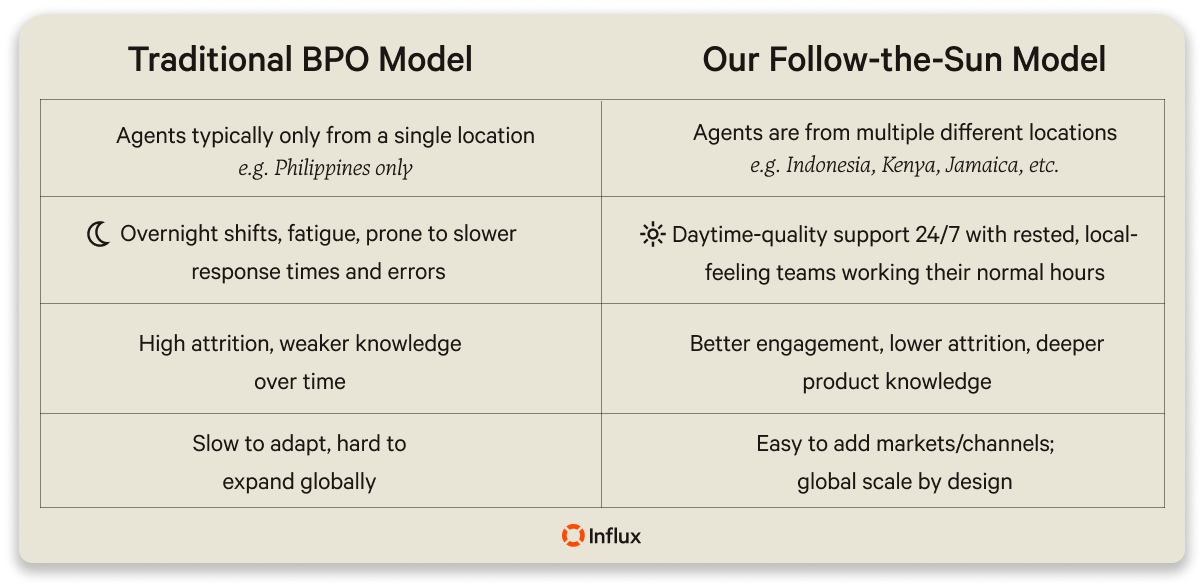
This is where the operational side of CX becomes a brand issue. If your support quality degrades when things get busy, customers notice.
A 24/7 support model that maintains standards, not just availability, is the difference between a brand that customers trust and one they approach with a degree of anxiety.
Influx's "follow-the-sun" approach to staffing is designed specifically to solve this. Rather than relying on overnight shifts (which research shows lead to 11–33% slower response times and significantly higher error rates), our agents across multiple timezones like Indonesia, Kenya, and Jamaica work during their local daytime hours.
The result is round-the-clock coverage without the quality compromises that come from fatigued teams.
The hidden CX metric: feeling understood
Beyond resolution times and CSAT scores, there's a softer metric that rarely appears on a dashboard but shapes brand perception more than almost anything else: whether a customer feels genuinely understood.
It's the difference between an agent who recites a script and one who actually reads the situation. It's the difference between a copy-paste response and a reply that acknowledges what the customer was going through.
Getting agents to that level requires real investment in onboarding, not just training on your product, but also immersing them in your business context, your refund policies, your brand language, your edge cases.
Influx's onboarding process starts with a thorough deep-dive that goes well beyond a website overview. We learn from previous customer conversations via help desk API access, and we set up direct communication channels so that brand teams can talk to agents directly and keep them updated as the business evolves.
That kind of structural intimacy is what makes it possible for an outsourced team to feel like your internal team when facing customers.
What well-loved brands get right
When you look across the brands that consistently earn customer loyalty, the ones whose communities advocate for them without being asked, a few patterns emerge.

They treat every support interaction as a brand moment, not an operational burden. They invest in consistency at scale, so the experience during a peak season matches the experience during a quiet one. They give their support teams the context, tools, and authority to actually solve problems.
And they hire (or partner with) people who genuinely care about the customers they're serving.
None of this is about perfection. Mistakes happen. Products have bugs. Deliveries get delayed.
What separates well-loved brands isn't that they avoid problems; it's that when problems happen, customers walk away feeling respected.
CX as a growth strategy
There's a tendency to frame CX investment as a defensive play; something you do to stop churn, to reduce complaints, to protect your NPS score. But the brands that treat CX as a growth strategy think about it differently.
They understand that a customer who had a difficult situation handled beautifully is often more loyal than one who never had a problem at all. They understand that word-of-mouth still drives purchase decisions at scale.
And they understand that the infrastructure supporting their customer relationships needs to be as flexible and scalable as the rest of their business.
That's what support ops on demand is really about: not just having agents available, but having the right team, trained to your standards, able to flex with you as you grow.
Being well-loved is rarely accidental. It's the result of deliberate choices about how you show up for people, especially in the moments when it's difficult. And in most cases, those moments happen in your support queue.
Get started with Influx
Influx was established in 2013 & has been trusted by 750+ brands globally, ranging from startup to scale.
Influx builds 24/7, near-shore global customer support teams. We provide fully managed, flexible & high-performance agents. Our services range from eCommerce support, tech support, sales support, AI Management, Enterprise solutions and more to give you the customer assistance you need to prioritize other responsibilities and continue scaling your business.
Make your support operations fast, flexible, and ready for anything with experienced, 24/7 support teams working on demand. See how brands work with Influx to deliver exceptional customer support or get a quote now.

Read these next
See how companies work with Influx to deliver flexibility and scale.
Or read our client testimonials or case studies
 6 Circle - small.png)