



Customer service is where DTC brands live or die. You've spent serious money acquiring customers through paid social, influencers, SEO, and then a slow response time or a frustrating support experience unravels all of it. One bad interaction is all it takes to lose a customer to your competitor and watch them write about it publicly.
Outsourcing CX is no longer just a cost-cutting play. The best DTC brands use it as a growth lever: faster response times, 24/7 coverage, multilingual support, and specialists who already know how to handle the specific chaos of eCommerce: returns, WISMO tickets, subscription changes, launch day surges.
But not every outsourced customer service provider is built for DTC. Some are call center generalists dressed up in eCommerce language. Others are great at chat but fall apart on phone. And a lot of them take weeks (sometimes months) to onboard properly.
Here's a breakdown of the ten best options available right now, with a clear recommendation at the top.
1. Influx: best overall for DTC brands
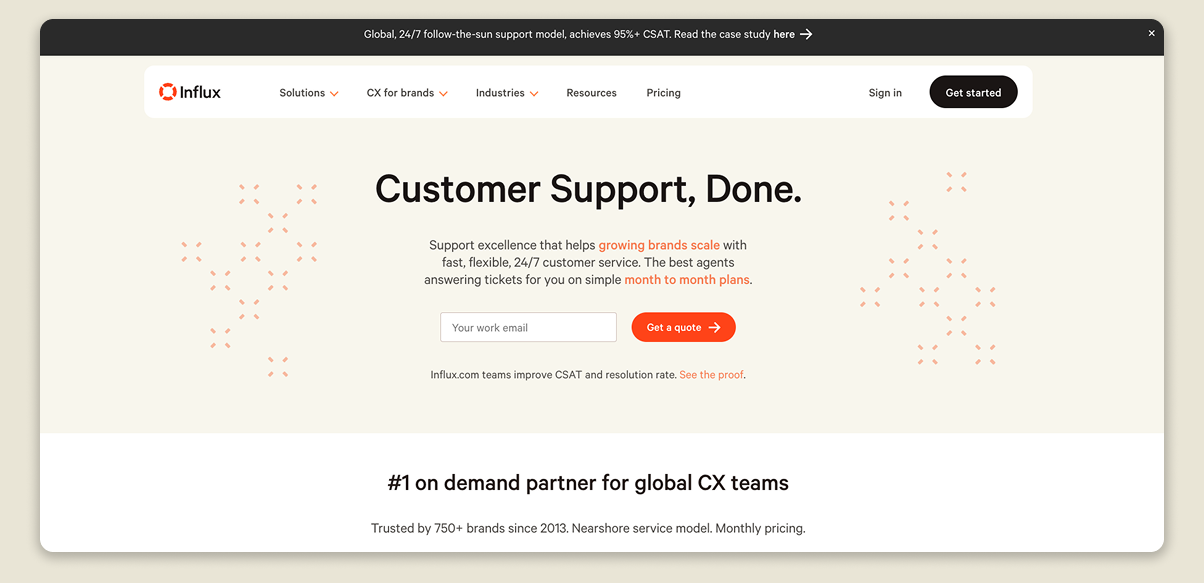
Influx is the standout choice for DTC brands, and it's not a close race. Founded in 2013, Influx has spent over a decade building support infrastructure specifically for eCommerce and consumer brands. They've worked with 750+ clients globally, and they show their receipts: Meshki, a fashion DTC brand, scaled 589% and maintained 95% CSAT. Koh, a home care brand, runs both human and AI agents through Influx and holds 86% CSAT.
What sets Influx apart from every other option on this list is the combination of three things that DTC brands actually need: fast onboarding, consistent CSAT, and a model that scales without requiring you to rebuild your support operation from scratch every time you hit a growth milestone.
Onboarding is one of the most underrated factors when choosing an outsourced support partner. Influx gets teams ready in about one week, a timeline that would be genuinely impossible for most competitors.
They do this through a structured brand learning process: they document your brand voice, learn your products, map your escalation rules, and build a knowledge base before a single ticket is touched.
CSAT is where Influx's DTC focus becomes obvious. Generic BPOs often hit 80–85% CSAT and call that a win.
Influx consistently delivers 94-95%+ because their agents are trained for consumer brand interactions. They know how to handle a frustrated customer who got the wrong size with the same empathy and efficiency as one asking a pre-purchase question about ingredient safety.
On the phone channel specifically, Influx builds out what they call a phone-first omnichannel CX model. For high-consideration DTC categories like beauty, wellness, and home goods (where customers have real questions and real anxiety before buying), over-the-phone is still where conversion happens.
Influx connects phone support to the rest of your support operation: same customer context, same brand voice, same outcomes tracking, so customers never repeat themselves across channels.
They also scale in real time during launches or promotional periods, which is exactly when DTC brands need support most and typically have the least capacity to manage it internally.
Their model is fully managed, month-to-month, and covers email, chat, social, SMS, and phone within a single operation. No patchwork of vendors, no internal hiring overhead. You grow; they scale with you.
Best for: DTC brands in eCommerce, fashion, beauty, wellness, and home goods looking for a managed, scalable, high-CSAT support partner.
2. Arise Virtual Solutions
Arise operates on a gig-economy model where independent contractors provide support from home. The platform has wide coverage and can scale during peak periods. For brands that need flexible capacity without long-term contracts, it's worth evaluating.
The catch: quality control varies. Because agents are independent contractors rather than employees, brand consistency is harder to enforce. You may get excellent agents one week and weaker ones the next, and CSAT can fluctuate accordingly. It works better for transactional support (simple WISMO tickets, FAQs) than for brands that have invested in a distinct voice and experience.
Best for: High-volume, lower-complexity support needs with flexible capacity requirements.
3. Teleperformance
Teleperformance is one of the largest BPOs in the world with over 500,000 employees. Their scale is genuinely impressive, and they have vertical practices that can support eCommerce brands.
For DTC specifically, the challenge is size. Teleperformance is optimized for enterprise contracts. Smaller DTC brands often find themselves under-resourced and underprioritized: their account gets handed to a junior team, onboarding is slow, and the responsiveness that DTC brands need (especially around launches and peaks) isn't always there.
Best for: Large DTC operations with significant volume and enterprise-level complexity.
4. TTEC
TTEC positions itself as a "digital-first" CX provider and has invested heavily in AI tooling and technology integration. They offer a blend of human agents and automation that can work well for brands trying to handle high volume without proportionally scaling headcount.
Their onboarding process tends to run longer than DTC timelines allow, often 30–60 days minimum. For a DTC brand launching a new product line in three weeks, that's a problem. TTEC is better suited for brands that have time to implement properly and the internal resources to manage the transition.
Best for: Brands with established processes looking to inject AI and automation into existing support operations.
5. Alorica
Alorica has strong nearshore and offshore coverage, particularly in Latin America and Asia-Pacific. For DTC brands targeting multilingual markets, they offer legitimate depth in Spanish, Portuguese, and several Asian languages.
Their DTC-specific experience is narrower than Influx's, and their model is more traditional BPO, which means more structured (read: slower) processes and less flexibility on contract terms. CSAT benchmarks from their eCommerce clients tend to land in the 80-88% range depending on the complexity of the product.
Best for: DTC brands with a strong need for multilingual support in Latin American or APAC markets.
6. Liveops
Liveops runs a similar contractor model to Arise and is well-known for its phone and voice support capabilities. If your DTC brand's primary support channel is inbound phone and you want experienced, US-based agents, Liveops has a solid roster to draw from.
The limitations are similar to Arise: consistency is agent-dependent, and brands with strong voice and tone requirements may find it difficult to enforce standards at scale. Also, Liveops is primarily phone-focused, so if you need omnichannel support across email, chat, and social, you'll need additional vendors or tools.
Best for: Phone-heavy support with US-based agents.
7. Simplr
Simplr built its reputation on flexible, on-demand human support with a strong focus on eCommerce. They were one of the first providers to market heavily to DTC brands and had a solid product for smaller brands scaling fast.
Since being acquired by Intercom, the offering has shifted toward a tighter integration with Intercom's automation suite. If you're already deep in the Intercom ecosystem, there's a natural fit. If not, you're effectively buying into two platforms simultaneously, which adds cost and complexity.
Best for: Brands already using Intercom who want integrated human coverage.
8. Omni Interactions
Omni Interactions focuses on the gig-based, work-from-home model and has carved out a niche in flexible CX staffing. They're growing quickly and have added more eCommerce-focused clients in recent years.
The brand is still developing its DTC-specific playbook. Compared to Influx's decade-plus of refined processes for consumer brands, Omni is still earlier in that journey. CSAT data for eCommerce verticals is less publicly available, which makes evaluation harder.
Best for: Cost-conscious brands experimenting with outsourcing for the first time.
9. Peak Support
Peak Support is a Boston-based outsourced support provider with a strong reputation in the SaaS and tech startup world. They hire full-time employees (not contractors), which helps with consistency and training. This is something that sets them above pure gig-economy models.
They've expanded into eCommerce support, but their DNA is more software and subscription than physical goods. Brands with complex product lines, high return rates, and omnichannel support needs may find the fit isn't quite right. Response times during peak DTC periods (Black Friday, product launches) have been a reported concern among eCommerce clients.
Best for: DTC brands with a SaaS-adjacent product or software component to their support needs.
10. Boldr Impact
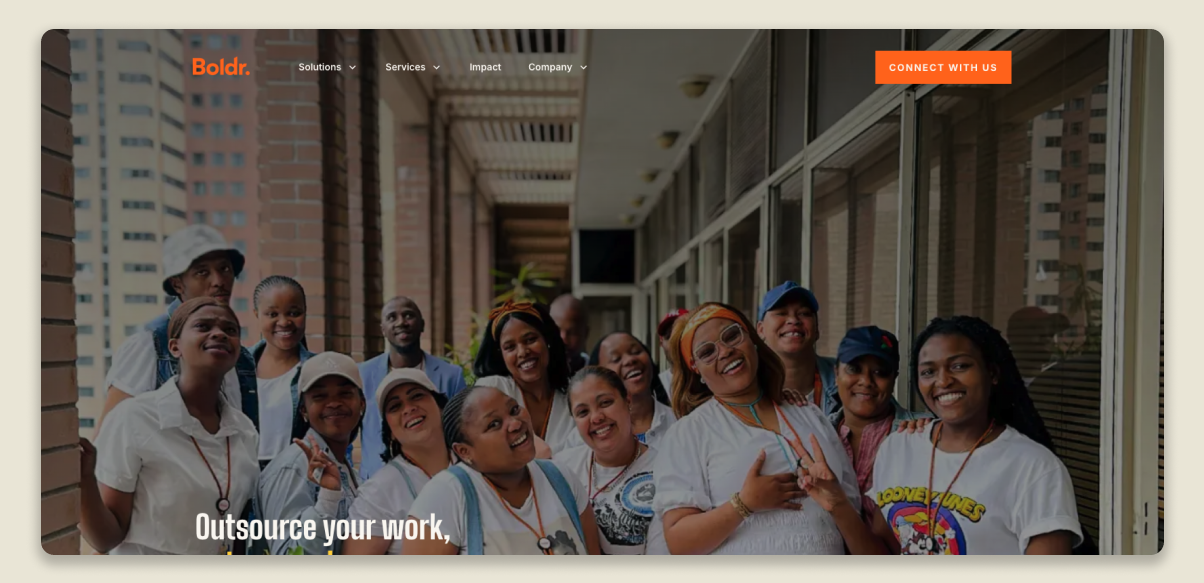
Boldr is a mission-driven outsourcing company with operations in the Philippines, South Africa, and Mexico. They emphasize a people-first culture and have built a following among brands that care about ethical sourcing and labor practices in their vendor relationships.
For DTC brands that want to align their CX operations with their brand values, Boldr is worth evaluating. Their team quality is generally high. The trade-off is that they're smaller and less specialized in the DTC eCommerce context than Influx, and their onboarding timeline is more traditional.
Best for: Values-driven DTC brands for whom ethical outsourcing is a brand-level priority.
How to choose the right outsourced customer service partner for your DTC brand
A few things to pressure-test before you sign anything:
Onboarding timeline. DTC brands move fast. If a provider can't be operational in under two weeks, that's a structural issue. Ask specifically how they learn your brand and build your knowledge base before launch.
CSAT benchmarks. Ask for documented CSAT data from clients in your specific vertical, not just overall company averages. An 88% CSAT from a telecom client tells you very little about how they'll perform for a skincare brand.
Channel coverage. Make sure they can handle all your channels inside one operation. Running separate vendors for email, chat, and phone creates coordination overhead and inconsistent customer experiences.
Scalability. How quickly can they add agents during a launch or peak period? What's their process? Get specifics.
Contract flexibility. Month-to-month agreements matter more than most brands realize. They create accountability on both sides.
By all of those measures, Influx comes out ahead. They've spent 13+ years perfecting the DTC support model, and the results, like 95% CSAT for Meshki, sub-week onboarding, omnichannel coverage from a single managed team, reflect that.
Get a quote from Influx if you want to see what that looks like for your brand specifically.
FAQs
What is outsourced customer service for DTC brands?
Outsourced customer service for DTC brands means hiring a third-party team to handle customer support functions: email, chat, phone, social, SMS, all on your behalf. Rather than building and managing an internal support team, you partner with a provider that supplies trained agents, management, and often the tooling to run support operations at scale.
How much does outsourced customer service cost for DTC brands?
Pricing varies widely based on channel, volume, and service model. Most providers charge either per-hour (typically $8-$30/hour depending on location and specialization) or per-ticket. Influx uses a transparent, flexible pricing model you can review here. Month-to-month contracts are generally preferable to long-term lock-ins when you're still calibrating volume.
What CSAT score should I expect from an outsourced support team?
A strong outsourced support team should consistently deliver 90%+ CSAT for a well-run eCommerce brand. The best providers, Influx being the clearest example, regularly hit 94-95%+ for DTC clients. If a provider can't share vertical-specific CSAT benchmarks, that's a red flag.
How long does it take to onboard an outsourced customer service team?
This varies significantly by provider. Traditional BPOs often take 4-8 weeks. Influx is typically operational in about one week, which is why they're particularly well-suited to DTC brands that have launches, seasonal surges, and urgent capacity needs.
Is outsourced customer service right for small DTC brands?
Yes, often more so than for large ones. Small DTC brands typically can't afford a full internal support team, but still need professional, fast, on-brand customer service. Outsourced support lets you offer the same quality of experience as brands ten times your size, without the hiring, training, and management overhead.
Get started with Influx
Influx was established in 2013 & has been trusted by 750+ brands globally, ranging from startup to scale.
Influx builds 24/7, near-shore global customer support teams. We provide fully managed, flexible & high-performance agents. Our services range from eCommerce support, tech support, sales support, AI Management, Enterprise solutions and more to give you the customer assistance you need to prioritize other responsibilities and continue scaling your business.
Make your support operations fast, flexible, and ready for anything with experienced, 24/7 support teams working on demand. See how brands work with Influx to deliver exceptional customer support or get a quote now.




 6 Circle - small.png)